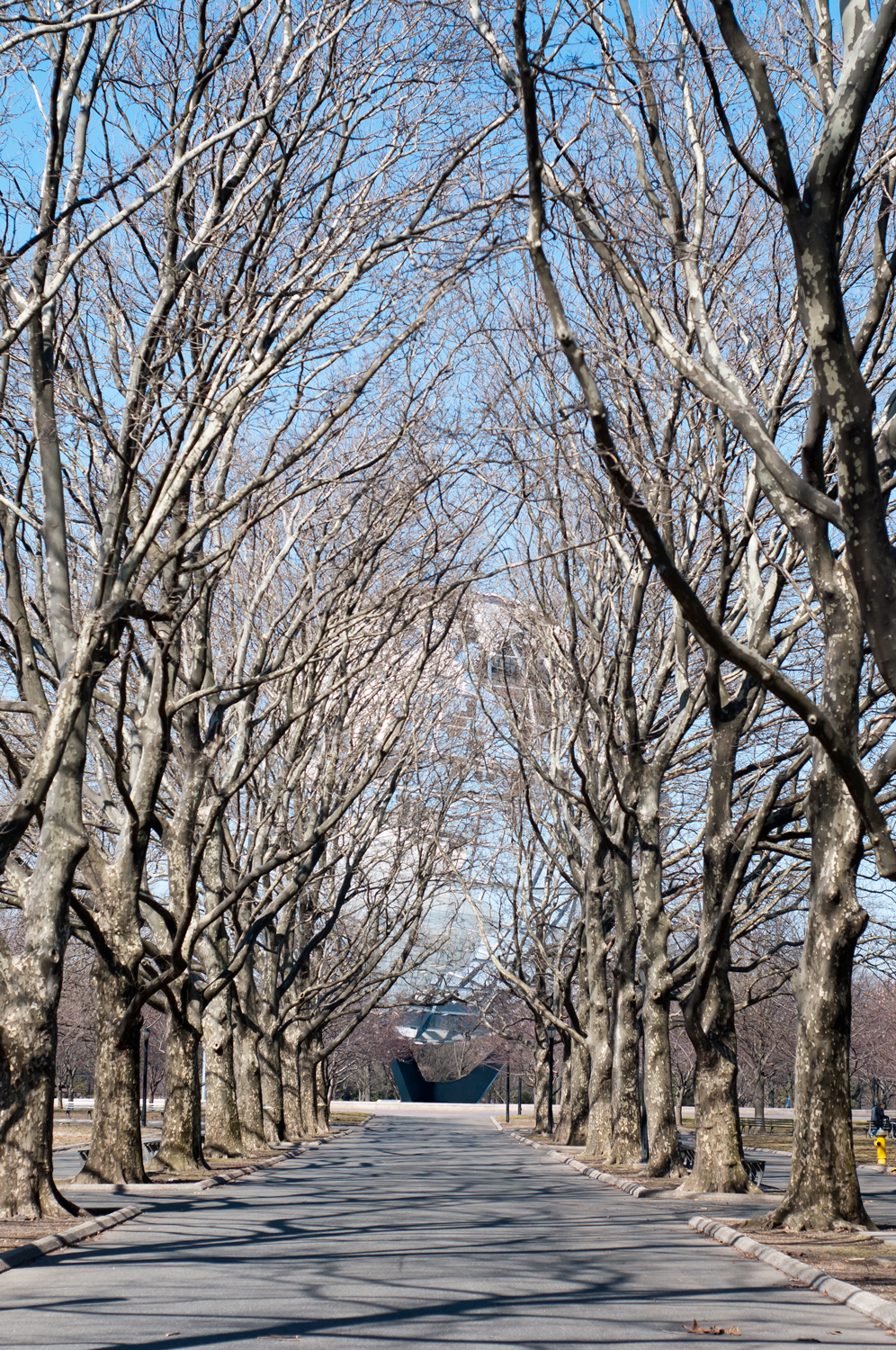
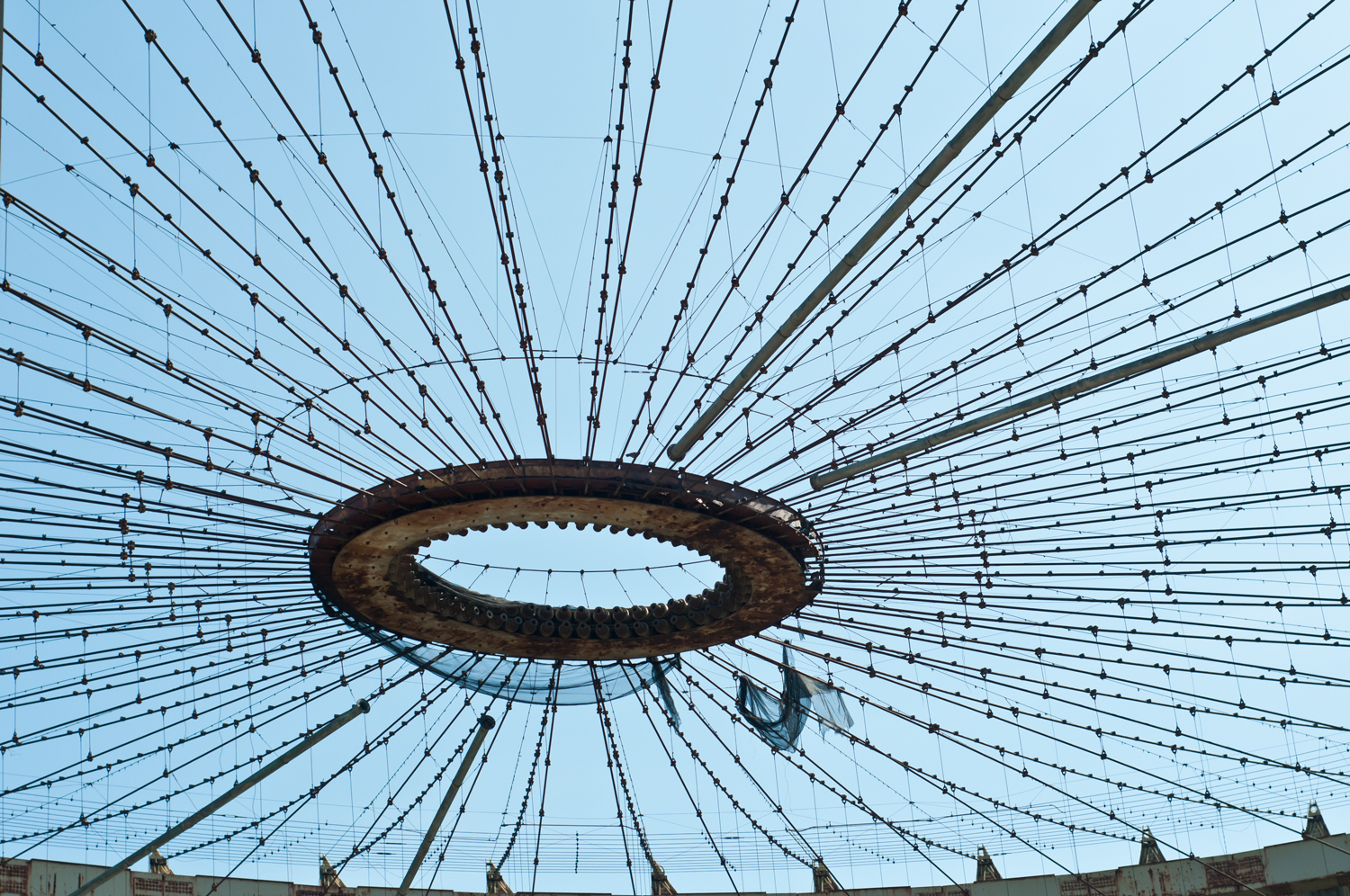
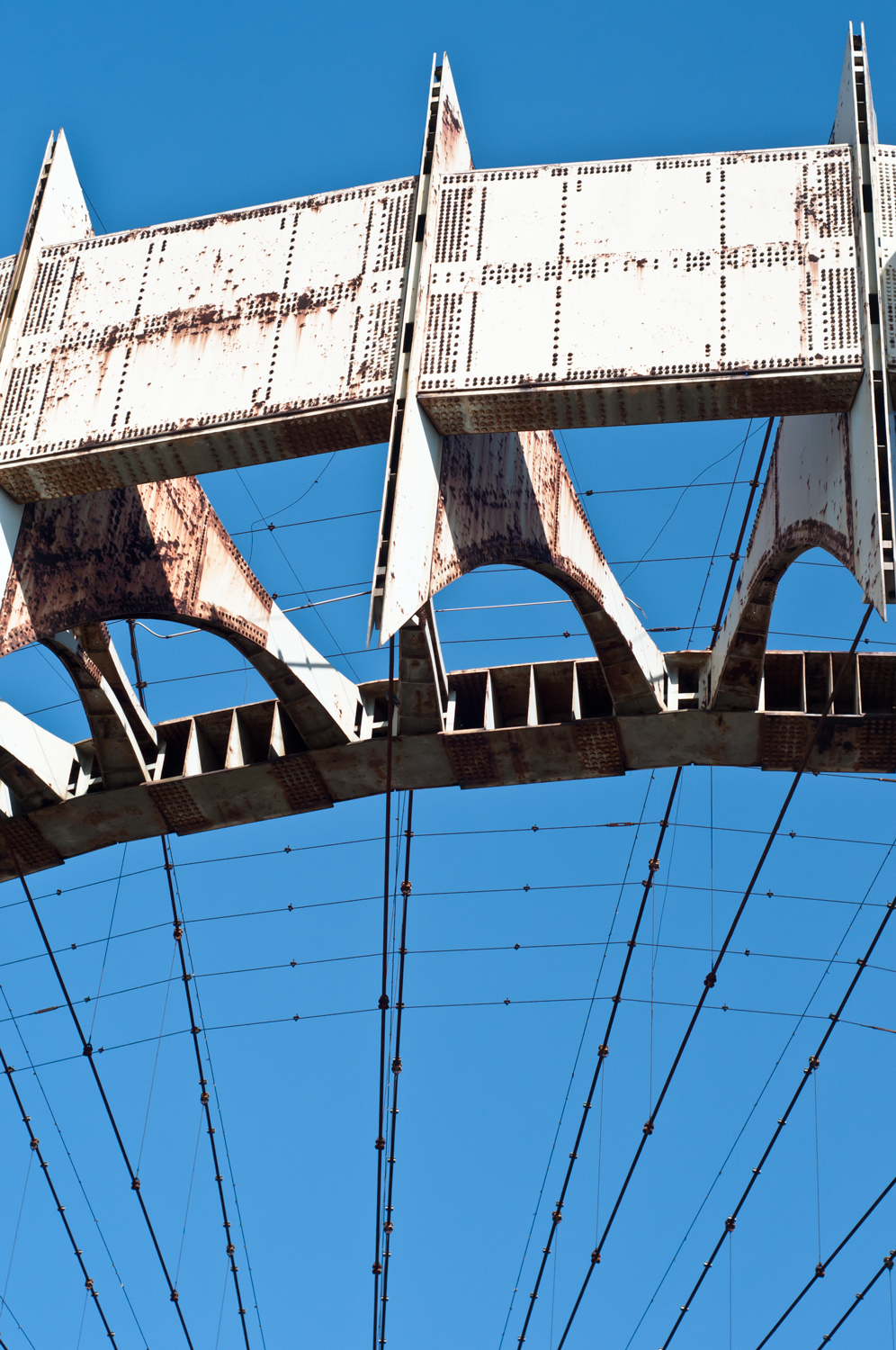
A recent early-Spring walk in Flushing Corona Park brought us up close and personal with ruins from the 1964 Worlds Fair. How I wish they still had Worlds Fairs. I would absolutely love to see one of the ‘house of the future’ exhibits.






Food • Photography • Life
A recent early-Spring walk in Flushing Corona Park brought us up close and personal with ruins from the 1964 Worlds Fair. How I wish they still had Worlds Fairs. I would absolutely love to see one of the ‘house of the future’ exhibits.
Today, April 8, 2013, food bloggers all over the country are taking place in Food Bloggers Against Hunger in an effort to raise awareness about the millions of people in this country for whom not knowing where their next meal is coming from is an everyday occurrence.
The question posed by The Giving Table, organizers of Food Bloggers Against Hunger is what would you do if you were hungry? Well, what would you do? Being hungry all the time isn’t fun in the slightest and not knowing how your next meal is going to happen is a terrifying prospect.
50 million people in the United States (including 1 in 4 children) are food insecure. This is in our country, where fresh food is thrown away by the boatload for being less than gleaming perfect. This in a country that has more than enough resources to provide food that is not only adequate but nutritious and affordable for every single one of its citizens. These are not just people without jobs and the homeless; food insecurity affects everyone including the very young, the elderly, and many working families in both rural and urban areas.
This issue is not partisan; it strikes at one of the most fundamental pillars of having a government; safety and the assurance that by joining up with a group of other people, life won’t have to be as hard as going alone.
I believe that if government is going to provide certain safeties (like a mechanism for assuring none of its subjects will starve to death – mechanisms for which our government and its peoples have made time and time again a priority), it should do an adequate job and make that safety readily available for all people who need it.
Of course I’d like to see that need fulfilled by private organizations; and private organizations do a sometimes great job of fulfilling that role – but not always and private organizations cannot be the complete answer. And that’s where government steps in. If we as a people can spend boatloads of cash legislating things like what grown people do regarding sex and money, waging a war on drugs and providing mad money to the very businesses some think are dragging this planet to the brink of destruction (I’m looking at you, Monsanto), I think we can certainly allocate tax dollars for something as fundamental as making sure all our school-aged kids have enough to eat so they can grow up to become a healthy and skilled work force. If this country, which by some metrics is the wealthiest and top in the world can’t assure its people can eat, who can? Aren’t we supposed to be #1? That’s some third world stuff right there.
And I don’t think this is just a money thing – education is also needed. Education about the types of foods that are healthy, how to prepare nourishing meals for your family, and exercise are all paramount in defeating this problem.
While I’ve never personally been on food stamps (or SNAP), I do remember what it is like to not really have enough money after the bills are paid to be able to afford any good kind of food. In college and right after, I waited tables – and preferred making sure my animals had food over myself because I could always snake a few yeast rolls for dinner or a 50 cent serving of pasta. I mostly subsisted on eggs and frozen hash browns, microwave popcorn, lean and light freezer meals, ‘dinner in a box’ kits, and pasta with frozen vegetables. And that’s pretty much what I could afford – when I could afford it. I was fairly certain that things like “real” meat and fresh vegetables were way out of my budget zone.
Where I live (Brooklyn, NY), SNAP recipients receive roughly $5.92 per person per day (more than the national average of $3-4). As a baseline example, I calculated my grocery budget on a two-person household (using a mother and child over age 5 as my guideline example). For this family of 2, SNAP pays out $367 per month, or $82.87 per week.
For more information on New York’s SNAP program, click here.
For my shopping, I stuck to my neighborhood Key Foods. This is the only “regular” grocery store within close walking distance of my house (there are plenty of bodegas and specialty stores like butchers, fish mongers and produce vendors) and plenty of other grocery stores (and farmers markets!) a train ride away; but I was figuring a single mother with a child would rather get her groceries in 1 shot between the train and home.
I spent $82.31 – enough for more than a week’s worth of healthful and vegetable packed dinners (that make enough so mom can have leftovers for lunch), breakfasts, and after school snacks.
The Menu
Breakfast
Oatmeal with sliced pears
Bacon, eggs and sweet potato hashed browns on one weekend day
Lunch
Each dinner meal makes enough for mom to take leftovers for work. School lunches cover the rest.
Dinner
Whole wheat pasta with mixed vegetables and fresh spinach dressed with olive oil, garlic and parmesan cheese
Lentils with fresh kale, bacon and eggs
Fried brown rice with pork and frozen peas & carrots
Beef chili with tomatoes, frozen mixed soup vegetables and fresh kale
Chicken meatballs with lemony chickpea mash and broccoli
Sweet potatoes with sausage and broccolini
Frittata with red potatoes, veggies and parmesan cheese
Snacks
Carrot sticks with hummus
The Grocery List
Whole wheat pasta – 5 for $5.00 (4 1/2 boxes left)
Frozen Italian blend mixed vegetables – $2.49 for a 16 ounce bag
Fresh spinach – $3.98 x 2 bags
Olive oil – $3.29 for an 8.5 ounce bottle (used about half)
Garlic – $1.99 for 5 heads (used 1 head)
Lentils – $1.19 for a 16 ounce bag (used half)
Fresh kale – $2.50 a bag
Bacon – $2.49 for 16 ounces
Eggs – $2.19 a dozen
Brown rice – $1.59 for 32 ounces (used a cup)
Frozen peas + carrots – $1.00 for 10 ounces
Pork stew meat – $1.09 for a pound
Ground beef – $3.99 for a pound
Canned diced tomatoes – $0.99 for a 14.5 ounce can
Kidney Beans – $1.59 for a 16 ounce bag dried beans
Mixed frozen soup vegetables – $1.99 for a 16 ounce bag (used half)
Onion – $2.97 for 3
Ground chicken – $3.59 a pound
Low sodium chickpeas – $1.19 per 15.5 ounce can – bought 2
Fresh lemons (2) – $1.00
Fresh broccoli – $1.50
Tahini – $3.89 for a 10 ounce jar
Sweet potatoes (4) – $2.97
Fresh broccolini – $1.99
Italian sausage – $1.99 a pound
Fresh carrot sticks – $1.49 for 16 ounces
Enriched Oatmeal (plain) – $2.99 for 18 ounces
Organic milk – $4.99 for 64 ounces
Fresh pears – $0.93 for 3
Chili powder – $1.69 for 4.37 ounces
Cumin – $1.50 for 3 ounces
Red skinned potatoes – $1.11 for 3
Fresh parmesan cheese – $4.49 for 8 ounces
Soy sauce – $1.19
No salt added vegetable stock – $1.09 for 8 ounces
Total: $82.31
The takeaway lesson: It is possible to eat healthful foods on a limited budget. It’s possible, but most people that need that information don’t really realize what foods make up a healthy diet.
In my view, the government solely providing funding or private charity solely providing groceries isn’t the answer – straight funding gets people eating processed, nutrient poor food and exacerbates the obesity problem (in turn hurting all of us); groceries are great, but they are often shelf-stable staples and don’t get at the heart of the problem. We need educational programs, advertising about the dangers of processed foods, and readily available resources SNAP recipients can use to learn about healthy eating and exercise.
If you’re interested in helping through governmental processes, click here to send a letter to your congressional representative urging protection for the federal funding that supports nutrition programs like SNAP, WIC and school meals.
If you’d like more information on the issue of hunger in America, check out the documentary A Place at the Table from Tom Colicchio and the people that brought you Food, Inc. either locally or on demand through iTunes and Amazon. You can check out the trailer for A Place at the Table here.
Pet charity plug: if you live in the NYC area, please consider donating to City Harvest. City Harvest is a great charity that works on rescuing trash-destined food from supermarkets and restaurants for New York’s hungry. Every dollar donated helps rescue four pounds of good food. Check them out.
The great people at The Giving Table have also been kind enough to sponsor a giveaway. I have two A Place At The Table companion books and two fork pins to give away to two lucky winners. Just comment below to enter.
The winners will be selected by random number generator. Comments will close on Friday, April 12 at Noon and the winners will be announced later that day.
This is a fabulous little fresh spring salad – full of bright crunch from the snap peas, balanced with nice bite from the radish and kicked up a notch by the addition of some nice flaky salt. A fresh, bright side for something decadent – like the lamb chops I served it with.

Fresh Snap Pea and Radish Salad with Sprouts
Snap peas (about 4 cups ?)
4 large radishes – I used plain old regular red radishes
1/4 cup sprouts – I used broccoli sprouts, though I bet the hot variety would be nice as well
3 Tbsp. almond oil
1 Tbsp. dijon mustard
1 Tbsp. rice vinegar
2 big pinches flaky grey salt
Black pepper (a dusting)
De-tip your snap peas and cut into rough fork-sized chunks.
Slice the radishes thin, stack the rounds up, and cut into match sticks.
Add both to a medium bowl with the sprouts.
Whisk together the oil, mustard and vinegar in a small bowl. Add the salt and taste – add some more if the tastes don’t pop.
Pour the dressing over the salad and work in, using your hands to toss and separate the sprout threads.
Dust with black pepper and serve.
Serves 2 for dinner + 1 for lunch as a side dish.
Farro is one of those whole grains that speaks volumes about comfort to me. It’s nutty and toothsome and just the thing to serve as a great base for any season’s fresh veggies. This dish takes all the best spring has to offer and ties it into perineal favorites like broccolini and lemon.

Spring Asparagus and Broccolini Farro with Kale Pesto
1/2 c. farro
1 c. vegetable broth
1 bunch broccolini
1 bunch asparagus
3/4 bulb fennel
1 Tbsp. olive oil
2 cloves garlic
1/2 c. water
1 Tbsp. garlic infused olive oil
1/2 c. kale pesto
Juice of 1/2 a lemon
Big pinch red pepper flakes
Salt & pepper to taste
Bring the farro and stock up to a boil in a medium pot. Cover, and simmer 10 minutes. Turn the heat off and let sit with the lid on an additional 5 minutes.
On to the veg. Chop the broccolini and asparagus into bite-sized pieces. Slice the fennel thinly. Chop the garlic. Add all to a large pan with 1 Tbsp. olive oil and sautee 5 minutes, stirring occasionally to avoid burning. Add the 1/2 c. water and continue sauteeing until water cooks out and everything gets nicely browned.
Tip the veggies out into a large bowl. Add the farro, garlic-infused olive oil, kale pesto, lemon juice and red pepper flakes. Taste for seasoning. Salt and pepper to taste.
Serves 2 for dinner + 1 for lunch.
This light and refreshing lunch incorporates some of the gorgeous Coriander-Carrot Vinaigrette from Gluten Free Girl and the Chef I made last week to accompany Quinoa with Southern Greens & Eggs, blending those sweet and bright flavors with the crisp bite of fennel and apple and the soft pliancy of toasted chickpeas.
A satisfying lunch that won’t leave you feeling bogged down and bloated.
Gluten-free. Easily modified to become vegetarian or vegan by omitting the tuna.
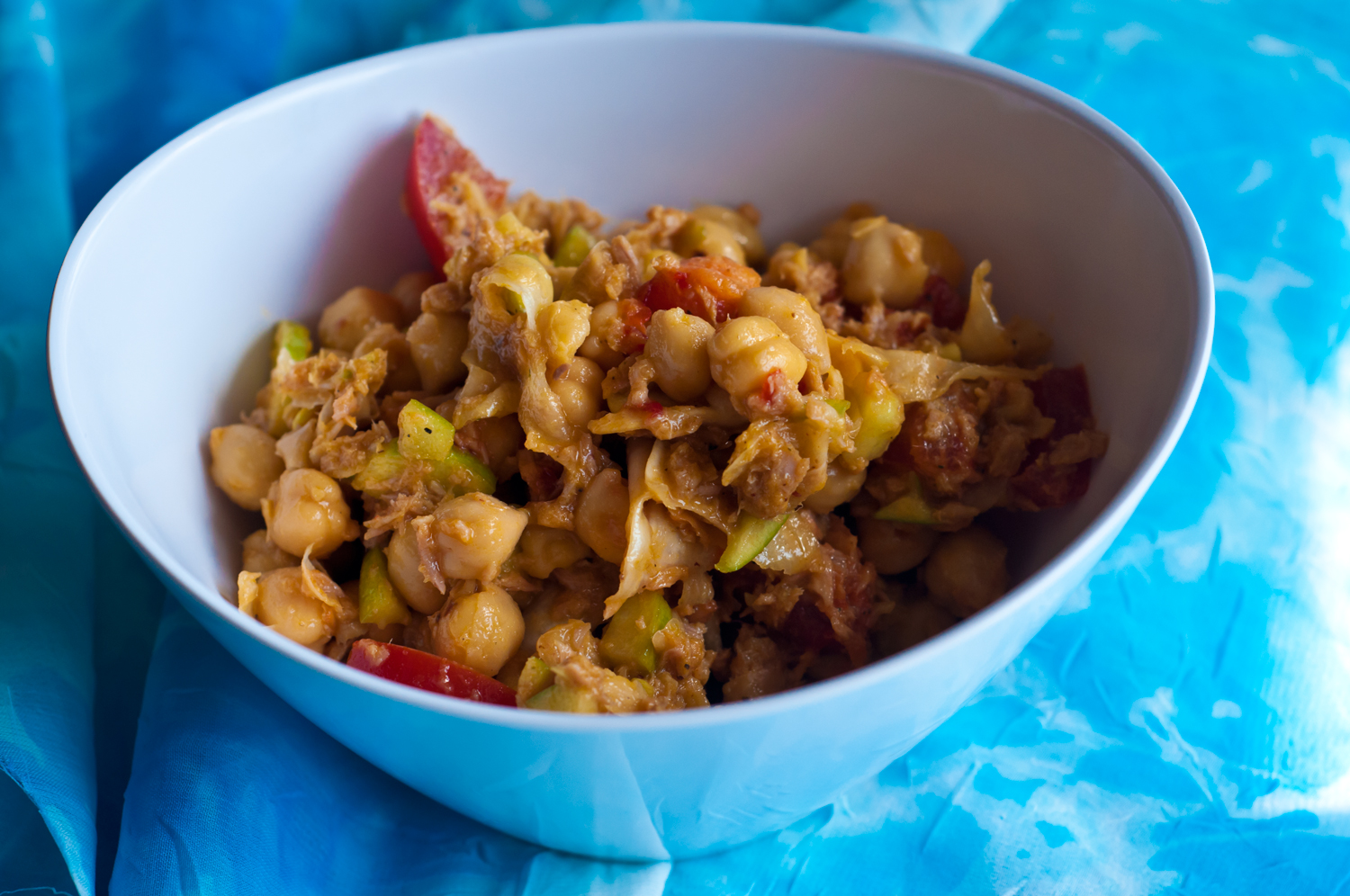
Chickpea, Fennel, Apple & Tuna Salad with Coriander-Carrot Vinaigrette
The recipe for Coriander-Carrot Vinaigrette can be found here.
1 can chickpeas, drained
1 pouch water-packed tuna
3 Tbsp. beet horseradish
1/4 Granny Smith apple, diced
1/4 bulb fennel, shaved
2 tsp. sriracha
2 tsp. lime juice
1 tomato, chopped
3 Tbsp. carrot-coriander vinaigrette
Citrus salt to taste
Drain and rinse your chickpeas. Add to a dry pan over medium heat and toast until beginning to brown. Add to a large bowl when done.
While the chickpeas are working, chop the tomato, shave the fennel, and dice the apple. Add to the bowl when done.
Add the rest of the ingredients and toss to coat. Taste for seasoning and add lime juice and/or citrus salt as needed.
Serves 2 for lunch.
This is one of those recipes that started with an idea and snowballed from there. I was reading Shauna Ahern’s post on Gluten Free Girl and the Chef about what salad meant during her childhood vs. what it means now, and was struck with the regional and generational similarities between her childhood idea of salad and mine. For her in California in the 70s, salad meant iceburg lettuce, tomatoes, croutons and Ranch dressing. For me in Ohio in the 80s, salad meant much the same – iceburg, crappy tomatoes, maybe some cucumber if you’re lucky, definitely some cheese, probably bacon bits, always croutons, and a big heaping helping of French or Catalina dressing.
Now, for the both of us (and it seems the nation as a whole, by and large), salad means much, much more. I eat some variation on a salad at least once a week for dinner and usually twice or more for lunch, and not even generally a lettuce-based variety.
I was also looking for a great quinoa main for the week and the vinaigrette sounded like an interesting new take on familiar ingredients. I stuck mainly to her ingredient suggestions for the ‘salad’ itself, subbing and adding as my pantry allowed. The vinaigrette I didn’t monkey with – over the years I have come to trust her vision regarding taste building (especially with sauces). I’m thinking about possible additions, but nothing is really resonating – I might add some smoke next time through cumin or chili powder because I’m on a smoke kick; but the vinaigrette is great without that note.
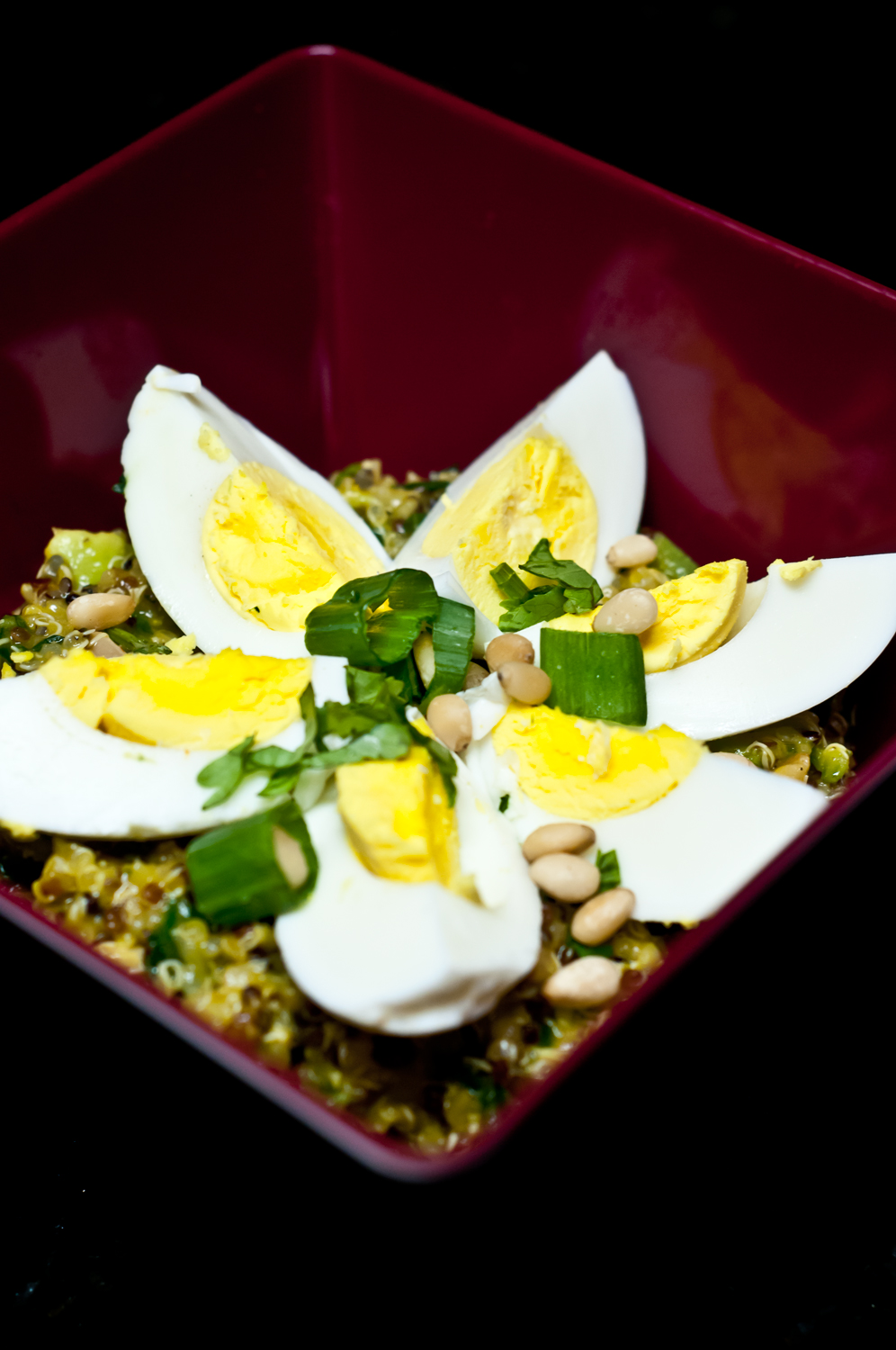
Quinoa with Southern Greens & Eggs
1 c. quinoa
2 c. chicken, turkey or vegetable broth
3 c. mixed Southern greens (collards, turnip greens, mustard greens)
1/4 c. pine nuts
4 eggs
1/2 avocado
1/4 c. or so Carrot-Coriander Vinaigrette (see below)
Salt & pepper to taste
Rinse the quinoa and add to a medium pot with the stock. Bring to a boil, cover, and reduce heat to a simmer. Cook 15-20 minutes or until liquid is absorbed and curlicues open up.
Add your eggs to a small to medium pot and cover with water (cover + 1 inch). Put over high heat and bring to a boil. Boil 1 minute, cover, and turn off the heat. Let sit 8 minutes. When the eggs are cool enough to deal with, peel and cut into quarters.
Wash, de-stem and chop your greens roughly. Bring a large pot of water about half full up to a boil. Add a palm of salt and the greens. Boil 5 minutes and drain.
In a small dry pan, toast the pine nuts until browned.
As your ingredients are ready (minus the eggs), add to a large bowl. When everything is there (minus the eggs and avocado), toss to combine. Chop the avocado and add to the bowl, along with the vinaigrette. Toss and taste for seasoning. Add more salt or dressing as needed. Spoon into a bowl and top with egg quarters.
Carrot-Coriander Vinaigrette
2 tsp. coriander seeds
2 c. carrot juice
1 medium shallot
1/4 c. red wine vinegar
3/4 c. olive oil
2 Tbsp. cilantro
Salt & pepper to taste
For instructions, see the original post from Gluten Free Girl and the Chef
I missed quinoa during my paleo excursion. I missed whole grains in general, to tell the truth. But, I feel like I learned another tool for my eating healthy and right arsenal – one that will help keep me mindful about not eating starch for starch’s sake and about nutrient quality/quantity in my dishes.
I first served this dish with the seared scallops called for in the original recipe, and man were they good. Then I ate the leftovers as-is with a bit more fennel for bulk, and that was great too. This dish is a winner all around.
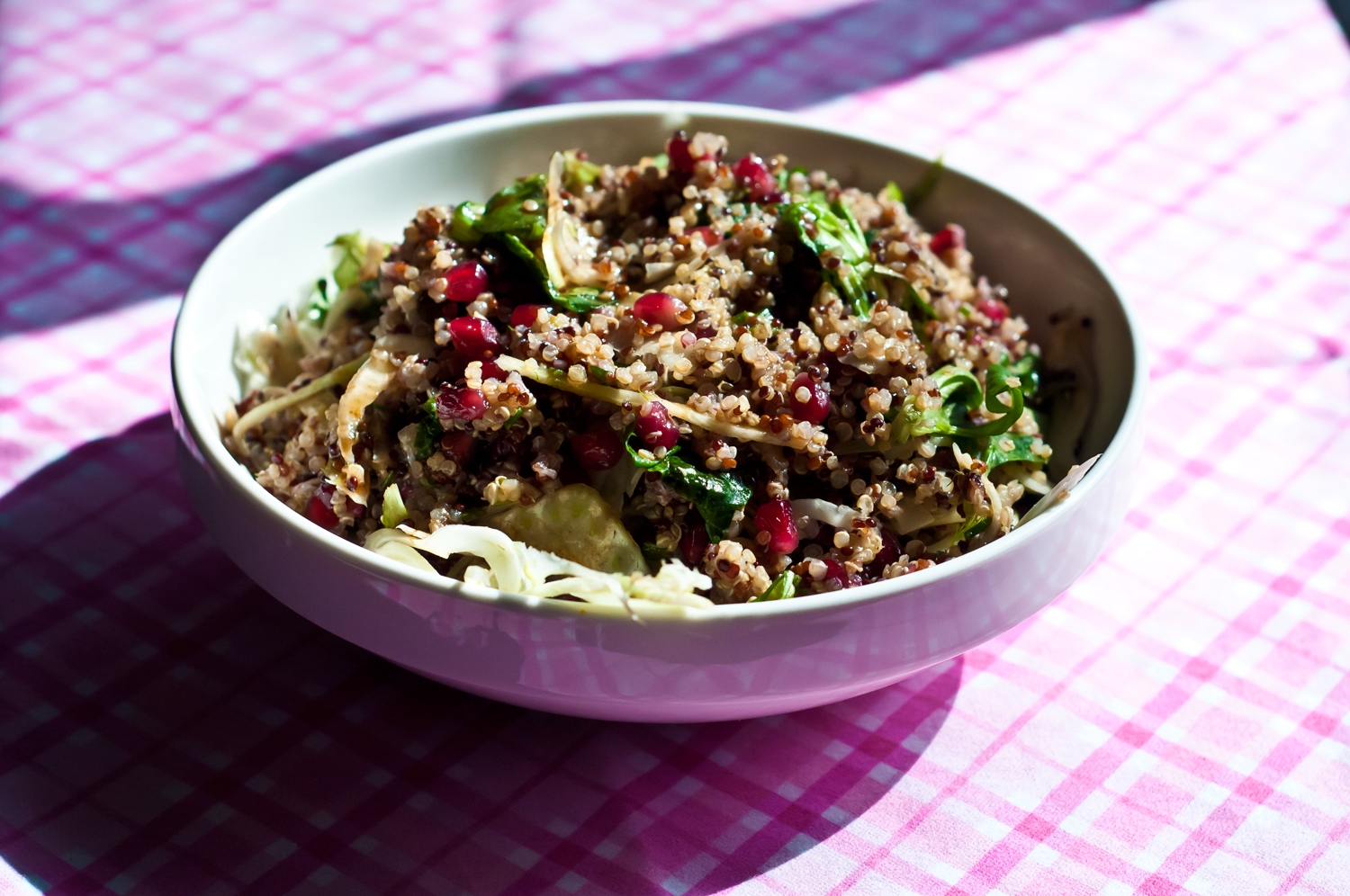
Quinoa Salad with Pomegranate Vinaigrette, Shaved Fennel & Mache
Adapted from Seared Scallops on Black Quinoa with Pomegranate Gastrique by Sprouted Kitchen
1 cup quinoa
1 1/2 c. vegetable broth
1 bulb fennel
2 Tbsp. extra virgin olive oil
1/4 c. chives
1 c. pomegranate arils
4 oz. mache
2 Tbsp. pomegranate molasses
3/4 c. vegetable broth
Rinse your quinoa and put into a medium saucepan with the 1 1/2 c. vegetable broth. Bring up to a boil, cover, reduce the heat to a simmer, and let simmer 18 minutes or until the broth has absorbed and each little grain has opened to a curlicue.
While the quinoa is working, tackle your vinaigrette and the rest of the salad. In a small saucepan, bring the pomegranate molasses and remaining vegetable broth to a boil. Let go until reduced by half or so, about 6-8 minutes. Set aside to cool.
Slice your fennel paper thin (I used a mandoline). Add to a large bowl with the mache, olive oil, pomegranate arils, and chives (which you have chopped or thinly sliced). Hit with salt and pepper.
When the quinoa is done, add to the bowl. Toss to combine and dress with the vinaigrette.
Serves 2 for dinner + 2 for lunch.
This quick and tasty lunch was a great way to use up some leftover slow-cooked lamb leg I had lingering in the fridge from earlier in the week.
Gluten-free and paleo-friendly.

Pulled Lamb with Sauteed Zucchini, Asparagus, and Preserved Lemon
1/4 c. pulled lamb (see recipe below)
1 tsp. capers
2 tsp. preserved lemon, diced
2 tsp. fresh thyme, chopped
6-8 spears asparagus (I used frozen asparagus spears from Trader Joes, but you can certainly use fresh)
1/2 zucchini, halved length-wise and sliced into batons
1 Tbsp. parsley, chopped
Salt & pepper
Coconut oil
In a large pan, heat 1 Tbsp. coconut oil over medium-high heat. Add the zucchini and sautee 1 minute. Add the asparagus and sautee until beginning to brown. Salt and pepper to taste. Remove to a plate.
Add 2 tsp. oil to the pan and put back on the heat. Add the capers and sautee until they start to pop. Add the lamb, preserved lemon and thyme and sautee until browned at the edges.
Serve on top of veggies with a sprinkle of fresh parsley to set the dish.
Serves 1 for lunch.
Pulled Lamb
I was originally set to make this lamb, but the only boneless lamb leg at the grocery store the day I went was pre-flavored
2 lb. boneless lamb leg (I used a black pepper marinated version from Trader Joes)
3/4 c. vegetable stock
Brown the lamb on all sides in a large skillet brought to screaming hot over high heat. Add to a crock pot with the vegetable stock. Cook on low 6-7 hours or until fork tender and delicious.
My DH hates turkey burgers with a passion. He hates their denseness, their dryness, and their (usual) complete lack of character.
He does not hate *these* turkey burgers. They’re juicy little flavor bombs with enough chew to make you not even notice the lack of a bun. And with this kicky little slaw as a side, the meal gets better and better.
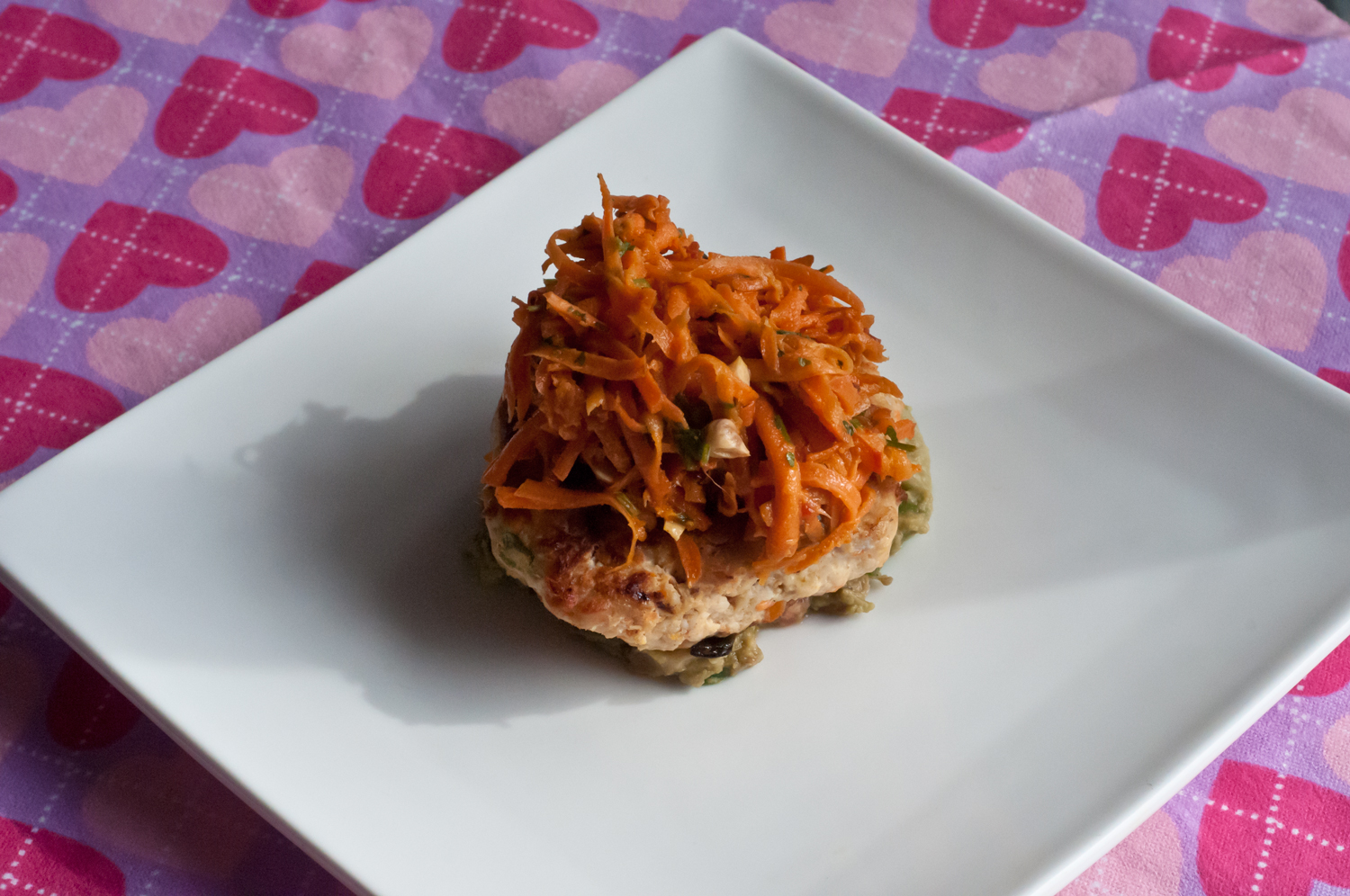
Thai-Style Burgers with Spicy Carrot Slaw and Sweet Potato Fries
Adapted from Thai Turkey Burgers by How Sweet It Is
Burgers
1 pound ground turkey (or chicken)
2 scallions
2 carrots
Big pinch salt
Few grinds black pepper
Coconut oil for the pan
Sauce
1/4 c. chili garlic sauce (Sambal Olek)
1/4 c. rice wine vinegar
1/2 c. canned coconut milk
2 Tbsp. maple syrup
1 Tbsp. almond butter
Thumb-sized knot ginger
1 lime
1 Tbsp. coconut aminos
Slaw Topper
4 carrots
1/2 c. cilantro
1/2 c. cashews
Sweet Potato Fries
1 large sweet potato
Grapeseed oil
Salt
Pepper
Smoky grill spice or any other really yummy seasoning meant to go on meat
First thing’s first. Let’s get those fries working. Set your oven to 425 (F). While your oven is heating, wash and peel your sweet potato and cut it into large fry shapes. (I had a huge over a pound potato, so I halved mine width-wise, then length-wise before cutting into oven fry shapes – you do whatever is appropriate for your potato size and shape).
Rub your fries with grapeseed oil and toss with salt, black pepper and some sort of yummy grill seasoning. I happen to have had a really good smoky seasoning I wanted to take for a test run.
When your oven is preheated, pop the fries in and set the timer for 12 minutes. When the time is up, flip your fries and set the timer for an additional 12 minutes – your fries should take from 25-30 minutes to cook total. Make sure to watch them during the last cooking period – they burn fast.
While the fries are working, move onto some mise. Grate all your carrots – I use a food processor, and it makes life much better. Portion out about 1/4 c. for the burger and 3/4 c. for the slaw. Add the burger carrots to one bowl and the slaw carrots to another.
Thinly slice your scallions and add to the burger bowl. Add the salt, pepper and turkey.
Chop the cilantro and add to the slaw bowl. Toast the cashews in a dry pan until just beginning to brown – remove and chop. Add to the slaw bowl.
Now move on to the sauce.
Grate the ginger and add to a small saucepan. Juice the lime and add along with the rest of the sauce ingredients. Whisk to combine (until smooth-ish). Bring the sauce up to a boil, reduce the heat to a simmer, and cook 3-4 minutes (or until beginning to thicken). Set aside.
And now for the burgers. Heat a large skillet over medium-high heat. Add 1 Tbsp. coconut oil and bring up to temperature.
Add 3-4 Tbsp. sauce to the burger bowl – work everything in the burger bowl until it comes together. Beware – the mixture will be pretty wet, but that’s ok. Portion out your patties and place into the skillet as you go – you should have enough for 4 nice-sized burgers. Cook the burgers 4-5 minutes per side, or until nicely golden brown. Be careful when flipping.
Add another 3-4 Tbsp. sauce to the slaw bowl and toss to coat.
To serve, top each burger with a heaping helping of slaw and more sauce if desired. The sauce also makes an excellent dip for the fries.
Can easily serve 4 for dinner with the appropriate amount of fries, or 2 for dinner with 2 lunches left over.
As I said last week, I know nothing about football, but I sure do like snacks. So when the Superbowl rolled around, I was more than happy to stay home eating “man food”.
The paleo nachos I posted last weekend were fabulous, but my DH was lamenting the bread hiatus in this house come game time (two of his favorite game snacks are on a bun: sliders and my mom’s ham & cheese sammitches), so I tried my hand at making that same great slider taste; just in a more paleo-friendly format. I think I did pretty well. The meatballs were very tasty – I had mine with some of my favorite tomato jam*; he had his with some store-bought pub cheese.
*If you’re going strict paleo and want to make this jam, substitute maple syrup for the sugar (I’d use about half the amount). You could probably also swap out the apple cider vinegar for some extra citrus juice, but I love the taste too much to do without. As always, check your labels for gluten if you’re intolerant.

Paleo-Friendly Slider Meatballs
1 Tbsp. coconut oil
1 lb. ground beef (grass fed)
2 Tbsp. onion powder
2 Tbsp. granulated garlic powder
1 Tbsp. umami paste (or Worcestershire)
2 Tbsp. fish sauce
2 Tbsp. coconut aminos
2 tsp. sea salt
1 tsp. black pepper
Add all ingredients but the coconut oil to a medium sized bowl.
In a large pan over medium heat, warm the coconut oil.
While the coconut oil warms, combine the bowl ingredients (I used my hands). When the oil is ready, form the beef into ping pong sized balls, placing into the pan as you go. I got about 13 out of my beef.
Brown on both sides and serve with everything you’d serve a slider with – pickles, cheese if you’re partaking, ketchup (or tomato relish), mustard … the toppings are endless.
 Gastography