Vegan Cheesy Gochujang Noodles

Some days I don’t know why I get into my head the taste combinations I do. This is not one of those days. For some reason, something a couple I love on YouTube had said in a video I watched who knows how long ago popped into my head and I just couldn’t shake the desire to find out what cheese + Gochujang tasted like.

(Side note: if you like food, are interested in either Asian cuisines or finding out what it’s like to live in either Korea or Japan as a North American expat, check out Simon and Martina’s channel and blog: Eat Your Kimchi. It’s well worth the binge watch. Find them, and the recipe whose vague memory inspired this one here. Now, back to your regularly scheduled blah-blah!)

Now, I can’t do animal cheese, and I’m not even trying to pretend that this version tastes like cheese cheese (I think if I added garlic powder and mustard powder it might – but I’m still reintroducing foods, and Gochujang was my challenge food today), but it has a hint of cheesiness and a nice richness from the coconut milk.

If you’re batch cooking this recipe, maybe add a bit more coconut milk to the mix – mine turned out a bit clumped-together for subsequent meals; it loosened up on heating and stirring, but it could have been a skosh freer in the storage container.

Gluten-free, vegetarian, vegan

Vegan Cheesy Gochujang Noodles

3 Tbsp. gochujang
1/4 c. sesame oil
1/4 c. soy sauce or coconut aminos
1/4 c. nutritional yeast
1.5 in. grated ginger
1/4 c. coconut milk
Garlic oil
Bok choy, chopped
Rice noodles
Green onions
Sesame seeds
Ketjap manis

First, boil some water and set your rice noodles to soak – I do 1/2 – 1 cup per serving.

While the noodles are soaking, chop the bok choy and sautée in a large skillet over medium-high in a few squirts garlic oil. Season with a little sprinkle soy sauce/coconut aminos to season.

While those are both going, whiz together the ingredients from coconut milk up to make a sauce.

Slice the green onions and set aside for garnish. If you’re not vegan, prep your protein too (egg, little shrimps and rotisserie chicken all go great here). Grab your sesame seeds.

When the bok choy is cooked to your liking, drain the noodles and add to the pan. Stir with tongs to break them apart gently and fully incorporate the veggies. Add the sauce and stir again. Cook everything together a few minutes.

Top with the green onions, a generous sprinkle of sesame seeds, optional protein, and a swirl of ketjap manis.

The sauce makes enough to support 2.5 big servings

Eggplant Soba

This recipe is the first stab at recreating a bread spread I had at lunch one day that was so magical I couldn’t for the life of me figure out what it was. I thought some form of mustard with cardamom, but no – hidden veggies! Yay, hidden veggies!

This version isn’t half bad. It isn’t quite there, so expect to see more attempts this summer – but it’s good. And it was delicious swirled into some leftover buckwheat noodles with nice crunchy radishes on top.

gluten-free, vegetarian, vegan

Eggplant Soba

4 small Italian eggplants
10 garlic cloves, halved
Neutral oil
1/2 small onion, chopped
2 tsp, fresh ginger, minced
1 Tbsp. ground cumin
3 tsp. ground coriander
1 tsp. ground cardamom
2 tsp. cayenne powder
2 tsp. lemon powder
2 Tbsp. rice vinegar
Salt & pepper
1 stack soba noodles per person to serve
2 – 4 thinly sliced radishes per person to serve
1 green onion, thinly sliced to serve

Halve your eggplants lengthwise and cross-hatch score. Salt, and lay face down on a cooling rack to drain for 10 minutes.

When your eggplants have drained, pat dry and preheat your oven to 200 – 220C. Line a baking sheet with foil or a silpat.

Fill the scores of the eggplants with the garlic halves. Drizzle some oil over top and sear in a large pan 3 – 5 minutes or until you get some color. Transfer to the prepared baking sheet face side up.

Roast eggplants 20 – 30 minutes or until softened and cooked through. Pull from the oven and set aside until cool enough to handle.

This is a good time to make the soba according to package directions.

When your eggplant is cooled, scoop the flesh into a blender or food processor.

In your searing pan, toast the onion and spices in 2 Tbsp. oil over medium-high heat until the spices are fragrant and the onions are beginning to go translucent. Add the mixture to the eggplant and blitz. Taste, add the vinegar (if desired) and salt and pepper to taste.

Serve tangled into the buckwheat noodles and topped with the green onions and radish if desired.

Makes enough sauce to feed 4

Quick Korean-Style Bowl

This bowl has it all: sweet, spicy, umami, crunch, shrimp – what more could you ask for? And it’s quick! Like 15 minutes, 1 mug & a bowl!

Gluten-free, pescatarian

Quick Korean-Style Bowl

Shrimp (I used half a pound or so small cooked shrimp, but uncooked would have been even better)
2 Tbsp. arrowroot powder or cornstarch
2 Tbsp. neutral oil
Two big hand fulls snap or snow peas
2 cups finely shredded carrots
2 green onions, sliced

For the sauce:

1 Tbsp. gochujang
2 Tbsp. hoisin sauce (or honey soy – something salty & sweet)
1 Tbsp. soy sauce (or coconut aminos)
1/2 inch fresh ginger, minced.
2 cloves garlic, minced
1 tsp. arrowroot powder or cornstarch
2 Tbsp. water

Heat your largest skillet over high. Add the oil to heat up.

While the oil is heating, toss the shrimp in the cornstarch.

Add to the pan, stir-frying until just beginning to brown.

Add the snap peas, stir-frying until warmed through.

Add the carrots, stir-frying until well distributed.

Add the sauce, stir-frying until the mixture looks homogeneous as possible and the sauce begins to thicken.

Add the green onions, give it a couple stirs, and serve.

Serves 2 for dinner, with or without 1 for lunch depending on whether this is all you eat

Korean Coconut Buddha Bowl

I’ve been quite excited to see a resurgence of bowl-related meals in the popular press (mostly because that’s what I’ve mainly been making for dinner since .. Miami) – Call them Buddha Bowls, Nutri Bowls, Glow Bowls … they all amount to the same basic formula: filling item, accents, protein source & sauce.

This version starts with a coconut curry, and wanders into the territory of Korea with the substitution of gochujang for red curry paste. Yum.

gluten-free, low carb

Korean Coconut Buddha Bowl

For the sauce

1 Tbsp. neutral oil
2 medium shallots
1 inch ginger
2 Tbsp. gochujang
1 can coconut milk
2 tsp. honey
1 Tbsp. sambal olek
2 Tbsp. fish sauce
2 Tbsp. soy sauce

For the bowl

1 Tbsp. neutral oil
1/2 onion
1 c. snap or snow peas
1 c. carrot batons
1 c. asparagus
2 c. shredded purple cabbage
2 Tbsp. soy sauce
1-2 Tbsp. lime juice
1/4 c. water

Optional: ground chicken & fried eggs

Sesame seeds

Mince the shallot & ginger and sautée in the oil until softened. Add the rest of the ingredients, whisk to combine, and let simmer 15 minutes or until thickened and velvety.

While that’s working, prep your bowl.

When your sauce is done, set aside, wipe your pan and add the oil + carrots. Stir. Add the onion and sautée until the onions are softened.

Add the peas and sautée, stirring frequently, until the peas are beginning to soften.

Add the cabbage and stir. Add 1/4 c. water and cook, stirring frequently, until the water has evaporated and the cabbage is crisp-tender.

Add the asparagus, soy sauce & lime juice and cook, stirring, a few minutes more.

Divide veggies between two bowls and top with ground chicken & fried egg if desired. Spoon over about a quarter to a third of the sauce per bowl. Sprinkle sesame seeds over top.

If you are after a shot for the ‘gram, cook all these veggies separately and arrange artfully. Ain’t nobody in this house got time for that.

Bowls serve 2 with leftover sauce

Gochujiang Tahini Bowl

This recipe is very loosely based on something I ran across in a PureWow email newsletter: creamy gochujiang sauce. I didn’t have time to click on the link when I saw it, so of course my brain turned it over all afternoon – wondering what that could possibly taste like, and what one would use for cream in a non-dairy way.

The original recipe looks fantastic – and if I’d gotten around to making this recipe in a week DH was home and I hauled myself to the grocery (instead of playing my favorite game: home Chopped), I would have loved to have added zoodles and maybe even coconut milk in place of the dairy.

As it stands, I used what I had on hand – and it was still fabulous. I can think of a ton of ways to use this sauce – in a poke bowl, with spare ribs and broccoli, slicked over mango and scallion, or fried up like bibimbap.

Gluten-free, vegetarian, vegan, paleo if you choose a non-soy variety

Gochujiang Tahini Bowl

Sauce

2 Tbsp. ajvar (or other red pepper) paste
1/4 c. tahini
2 Tbsp. gochujiang (check your labels for gluten free or paleo)
2 tsp. ginger/garlic paste
1 Tbsp. lemon juice
1/4 – 1/2 c. water

Bowl

Sugar snap peas
Broccoli
4 ounces protein (tofu or tempeh if vegan; rotisserie chicken if not)

Toppers

2 tsp. sesame seeds
1-2 scallions, sliced

Blend the sauce ingredients together, starting with 1/4 cup water. If needed, add an additional 1/2 cup – I wanted my sauce velvety but able to ribbon from my spoon, so I went for the full 1/2 cup. Taste – my ajvar was a bit spicy and my particular gochujiang was whatever the manufacturer deems as level 3. On first taste (after 1/4 cup water), the sauce was a touch spicy – diluting with more water took some of that spice out – so keep that in mind when choosing your thickness level.

Drizzle over your chosen bowl ingredients – I used a combination of quick stir-fried sugar snap peas and broccoli – and top with sesame seeds and thinly sliced scallions.

Makes enough sauce for 4 bowls 

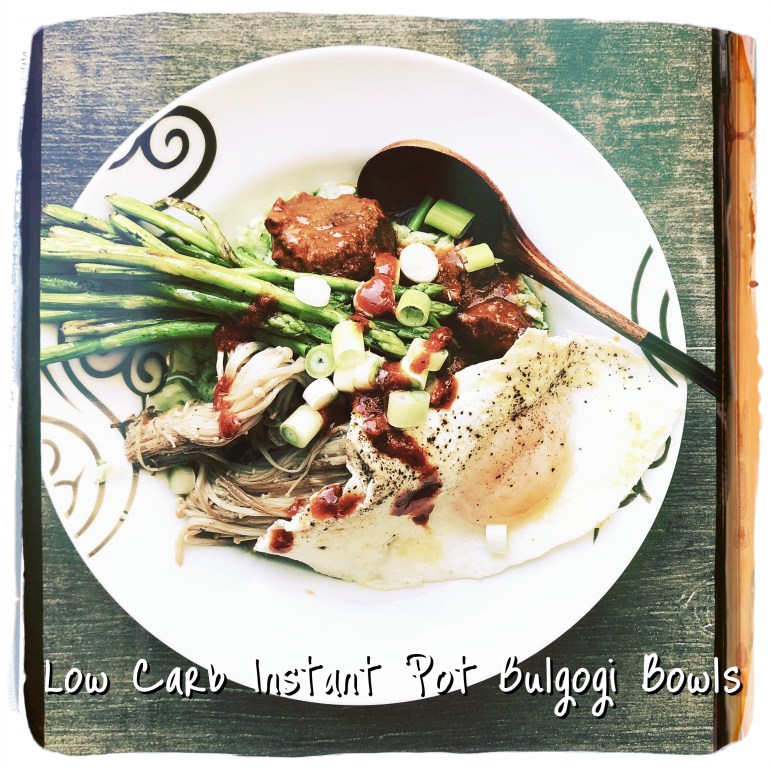
Low Carb Instant Pot Bulgogi Bowls

We’ve been on a Korean kick lately – and it’s been delicious. This recipe comes together relatively quickly, can be eaten hot or cold, and can accommodate a bunch of different eating styles.

Gluten-free, paleo-ish, keto-ish

Low Carb Instant Pot Bulgogi Bowls

For the Beef

3 – 4 lb. chuck roast
4 Tbsp. ginger garlic paste (or the equivalent chopped fresh)
1 small apple or pear, cored (I used Granny Smith, but I’ve heard Fuji is closest to a pear)
4 Tbsp. gochujang
1 Tbsp. sesame oil
1/4 c. tamari, soy or coconut aminos
2 Tbsp. rice wine vinegar
2 Tbsp. avocado or other neutral oil
1 date, pitted

Whiz all ingredients but the beef in your blender. Cut the roast into bite sized chunks and marinate 2 hours to overnight.

To prepare, pressure cook 12-14 minutes.

Bowl Fixins

Baby asparagus (I lightly sauteed in sesame oil)
Enoki mushrooms (I lightly sauteed with the asparagus)
Green onion slivers
Shredded carrots
Fried eggs
Bowl filler – I tried to “rice” cucumber, which ended up with cucumber pulp – which was a hot mess, but wasn’t bad when drained — DH had sushi rice, which he also pressure cooks and makes in big batches. Cauli rice would be great here, as would broccoli rice. Zoodles would work, too

Bulgogi Sauce

1 Tbsp. gochujang
2 Tbsp. tamari, soy or coconut aminos
1 Tbsp. ginger/garlic paste (or equivalent)
2 Tbsp, sesame oil
3-5 drops stevia

Whisk together and drizzle over the top of each bowl.

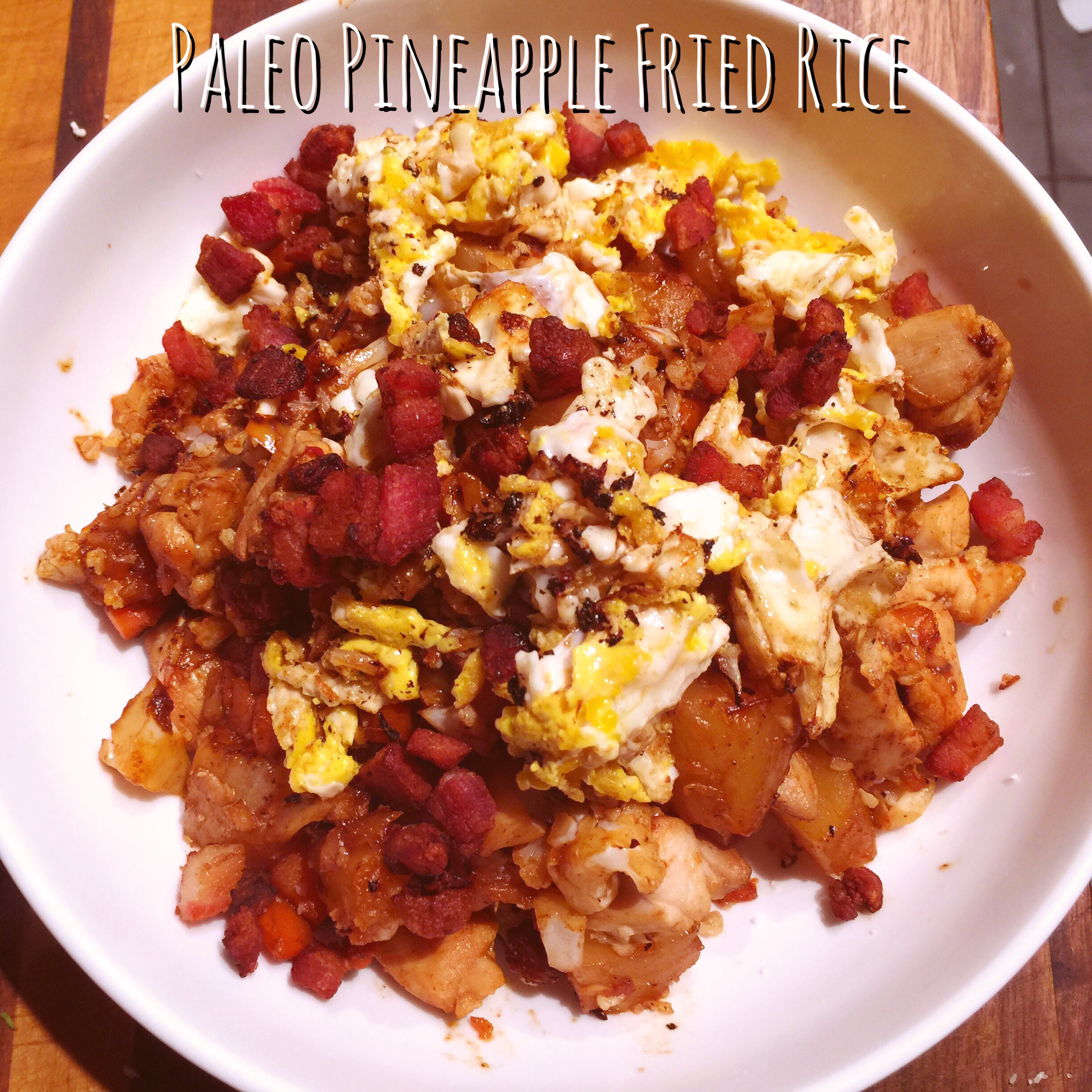
Paleo Pineapple Fried Rice

This meal was fantastic, and I was super happy I didn’t have to share with the DH. As written, this recipe makes enough for 1 dinner.

gluten-free, paleo

Paleo Pineapple Fried Rice

1/4 head cauliflower
2 ounces bacon
1 small carrot
1.5 chicken thighs
1/2 c. pineapple chunks in a little juice
2 cloves garlic
1/2 habanero
1 Tbsp. fish sauce
1 Tbsp. coconut aminos
2 tsp. lime juice
2 tsp. sambal olek
1 egg

First, prep your cauliflower by coring and chopping finely or running through your food processor to make rice-sized bits.

Brown the bacon over medium. While the bacon is browning, dice the carrot, mince the garlic, mince the habanero, and chop the chicken thighs.

When the bacon is browned, remove to a paper towel to drain. Pour off all but a Tablespoon of the fat and reserve.

Kick the heat up to medium-high, add the carrot and chicken to the pan, and sauté until just browned.

Add the pineapple, garlic and habanero. Sauté 1 – 2 minutes.

Add the cauliflower and sauté until half-softened.

Add the fish sauce, coconut aminos, lime juice and sambal olek.

Cook, stirring frequently, until the rice is soft and the pineapple is browned in spots.

Remove to a bowl. Add the reserved bacon fat to the pan and crack the egg in.

Let sit a minute (until half firm), and then start stirring. Cook until done.

Top the rice with the egg and bacon and enjoy.

Serves 1