I know, *another* hash. Can you get any more basic?
Nope. Nope you can’t. This girl loves breakfast, and hates eating dinner off of a plate at home. I also had an inexplicably strong desire for shredded zucchini, so hash it was.
I’m glad I listened to my weirdo craving – this was dang good. I’ll be making it again because this base is super versatile.
Some topping options:
Like I served it with leftover crumbled sausage, cherry tomatoes & Choula
Taco meat, guacamole and salsa
Chorizo or breakfast sausage & a fried egg
Turkey bacon & a fried egg (had this for breakfast the next day and it was 💯
Marinara & shredded protein of your choice with red pepper flakes
Salmon burger or crab cake with lemon aioli and capers
Let me know if you make any of these other options, tag me on Instagram @gastography – I’d love to see how they turned out!
On to the actual recipe.
gluten-free, paleo, vegetarian, vegan
Ignore my poor little abused Ikea bowl. She’s got problems.
Veg-Forward Hash Bowl Base
4 small waxy potatoes (about 2 cups shredded)
1 small red onion, shredded
1 large zucchini, shredded
2 cloves garlic, grated
1/2 cup sautéed minced red pepper & onion
Salt & pepper
Neutral oil
Shred the veggies and add in a pile to a clean tea towel. When all the veggies are in, twist as hard as you can to release as much water as possible. You want your mixture pretty dry so it picks up a bit of color rather than just steaming – if you’re me. You do you, though.
Heat a Tablespoon or so of your favorite fat over medium high heat. Add the squeezed veggies and stir to break up.
Hit with a generous amount of salt and pepper. Stir again.
Let sauté until browned to your liking. Add the pepper & onion mix. Stir to combine.
This process took me about 12 minutes to hit my desired level of brownness (stirring pretty frequently to avoid all-out burning) and for my potatoes to be cooked through.
You could also use frozen hashed browns here and that may take a different cooking time.
Taste for seasoning and hit with more salt, pepper or garlic powder if needed. Smoked paprika would also be nice here – cumin would be good, too. I made mine plain so I had maximum topping options.
This recipe came about because of a video from one of my favorite kitchen hack channels: RachLovesLife. She’s got a ton of videos testing viral recipes, and they’ve been great fun to watch over this past year & some change of varying levels of lockdown. She did a recipe on fry hacks, and this was something she mentioned wanting to morph one of them into – just with my own non-dairy twist, ‘cause I’m not trying to die.
gluten-free, non-dairy, comfort
Non Dairy Greek-style Frychos
3 boneless, skinless chicken breasts
1 bell pepper
1 red onion
2 cloves garlic
1/2 batch this 6-ingredient vegan tzatziki sauce from the Minimalist Baker
1/2 a block of vegan cheese (this is the one I used)
Olive oil
Salt, pepper, oregano
Optional toppers: sundried tomatoes, black olives
1/2 a bag of your favorite fries (I used McCann’s crinkle cut)
Chop the onion and pepper fairly small. Mince the garlic. Add to a pan with a couple teaspoons oil and sautee over medium until soft. If the heat is a little high and the mix looks like it’s going to burn before getting nice and soft, hit with a little water and let that evaporate off as the mixture steams a bit. Make sure to hit with salt, pepper and a couple teaspoons oregano as the mix cooks to season.
While the mix works, add the fries to the oven and bake according to package directions. Salt about halfway through baking.
After the veggies are done, remove from the pan.
Add the chicken, chopped into small bites, with a Tablespoon of oil. Sautée, seasoning with salt, pepper and oregano, until cooked through.
Set aside when fully cooked.
Dice or shred the cheese.
When the fries are browned to your liking, pull from the oven, and sprinkle with the cheese. Pop back into the oven long enough to melt the cheese.
To serve, pile cheesy fries on a plate, top with chicken & veggies, drizzle sauce over top and finish with the optional toppers.
Serves 2 for dinner with enough left over toppings for another couple meals – or a nice pasta the next night
This is a great grab-n-go to have in your back pocket any time you’ve got too many bananas and need a quick breakfast.
gluten-free, vegetarian, vegan
Chai Spiced Baked Oatmeal
2 cups rolled oats
1 Tbsp. ground cinnamon
1 Tbsp. ground ginger
1 Tbsp. ground cardamom
1 tsp. ground nutmeg
1 tsp. baking powder
1 tsp. salt
2 over ripe bananas
1.5 cups your favorite milk (I’ve used both hazelnut and oat milk and they were both great)
1/4 cup tahini
2 Tbsp. date molasses or maple syrup
2 Tbsp. chia seeds
3 Tbsp. pepitas
1 tsp. vanilla extract
Optional topper: a drizzle of nut butter, fresh or frozen berries, more banana
Preheat your oven to 200c/375F.
In a small baking dish, combine the dry ingredients. Mix to incorporate.
In a separate bowl, mash the bananas and add the wet ingredients. Stir to combine.
Pour the wet ingredients over the dry and mix to combine fully. If you still have little chunks of banana, mash them with the back of a spoon while combining. You want to make sure all the oats are wet.
Bake about 25 – 35 minutes, or until the bake is set and nicely browned.
Slice into 6 big squares and serve with your optional toppers.
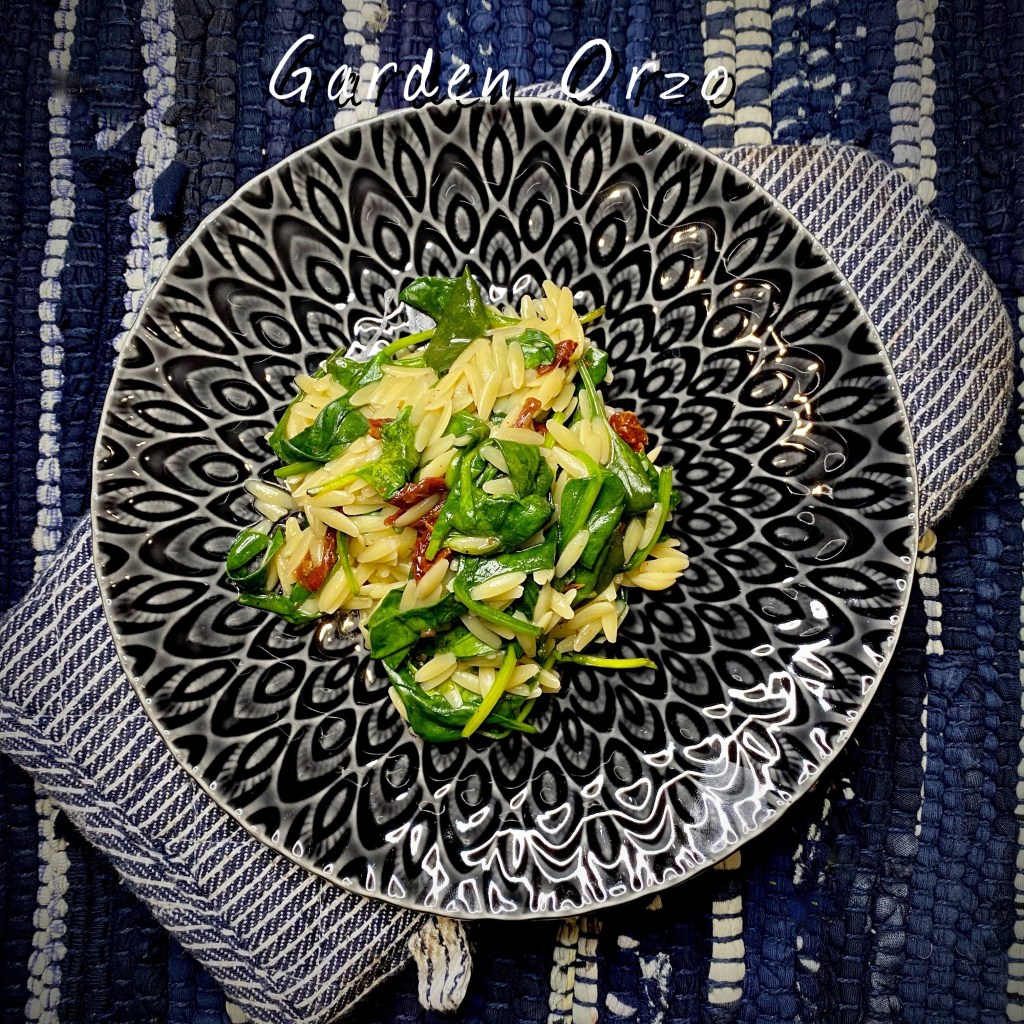
Orzo is an ingredient I under-utilize and I’m always surprised how much I like it each time I remember to make it. I’m imagining it’s because I spent years exclusively eating paleo, and have been into low carb for years upon that – but this is really good.
This recipe tastes fresh and makes a great accompaniment to next weeks recipe – a baked Mediterranean chicken. It’s also great as a standalone dish.
Vegetarian, vegan
Garden Orzo
1/2 cup orzo
1.5 cups liquid – I used 1/2 a cup of good stock & 1 cup of water; you do you, though I’d suggest using some good flavorful broth as well
6 sundried tomatoes
500g baby spinach
2 cloves garlic
2 tsp. your favorite oil
Optional add-ins: pine nuts, a good salty cheese (this one from Violife was what I used for the dish I made to go with and it was fantastic – they also make a “Parmesan” that would probably be great here), a squeeze of lemon juice, a sprinkle of Zaatar
Sauté the garlic in the little bit of oil until just beginning to turn tender.
Add the stock & water and bring up to a boil.
Add the orzo and cook, stirring quite frequently to prevent sticking, until just al dente, a minute or so before the cook time is up.
While the orzo is working, chop the sundried tomatoes.
When the orzo is al dente, remove from the heat.
Chuck the sundried tomatoes in, stir, and add the spinach on top.
Let steam a couple minutes, and stir the wilted spinach in.
I make this – or a variation on this – quite often for lunch later in the week, when I’ve got leftovers kicking around in the fridge, am out of my main protein, and still have some of this week’s spinach hanging around that is quickly going to age itself right out of my fridge.
For this version, I resisted the temptation to go Southeast Asian like usual (this dish 99.9% of the time turns out vaguely Japanese), and went Indian instead. I’m glad I broke out of my comfort zone a little and I think I’ll make this again on purpose for dinner some night.
To reheat your rice – any rice – without it drying out, add a Tablespoon or two of water, put the lid back on really loosely and zap in the microwave for :45 to 1:00. Boom. Steamed and refreshed rice.
Fry the eggs to your liking in the oil, seasoning with salt and pepper and adding a liberal sprinkle of turmeric when you flip. Add the spinach on top of that to wilt a couple seconds while the yolks finish setting to your desired doneness (I love a good runny yolk, so I separated my whites from yolks, scooted them to the side and added the spinach more to that side so I could see to yank the yolks when they were just barely set).
Grate the ginger and garlic into the rice.
Mince the chili (de-seeding if necessary) and add to the rice.
Add the eggs on top, along with a small hand of the crispy chickpeas.
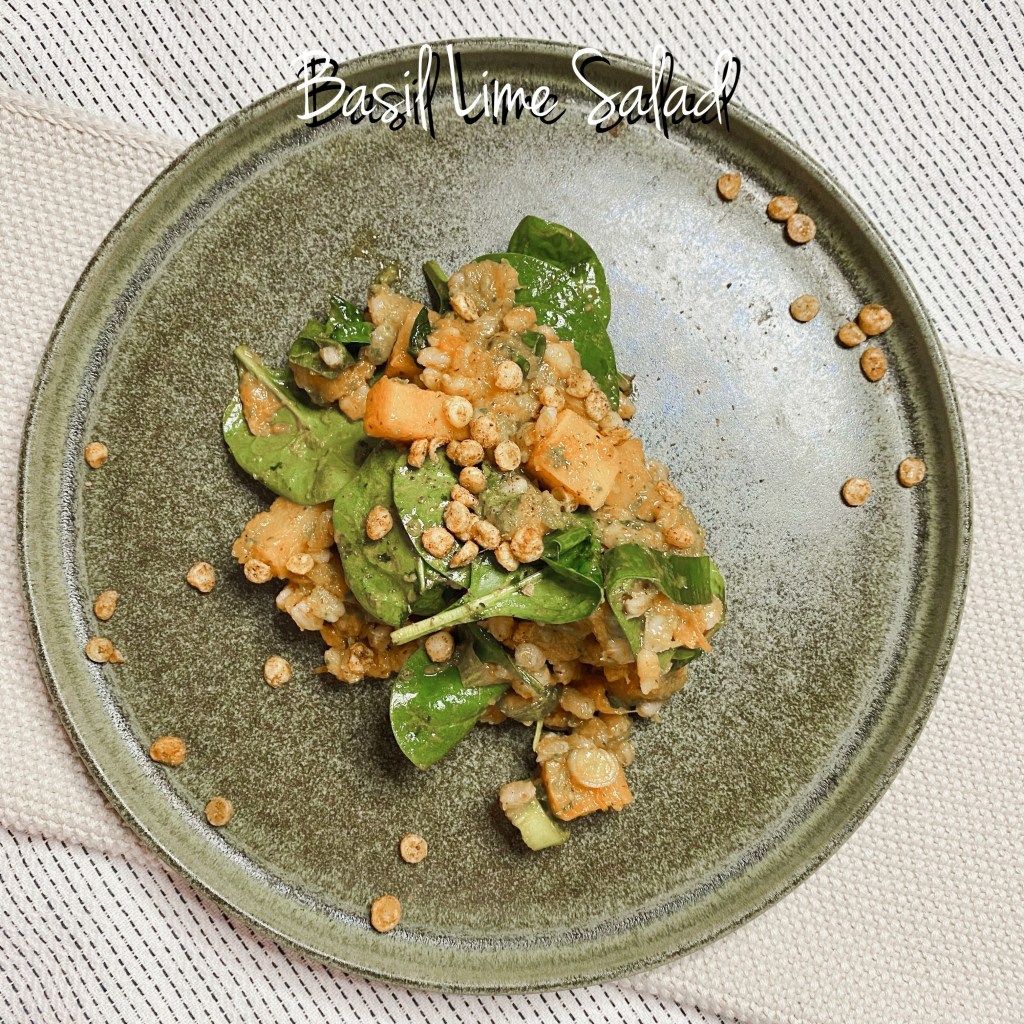
This is a surprisingly light tasting salad for having not only chewy pearl barley but roasted pumpkin. I think it’s the dressing and all the fresh spinach.
If you make extra dressing, and I suggest that you do – it pairs great with a more traditional salad, simple cold noodles, and even as a dip for chicken or shrimp. It’s delicious.
vegetarian, vegan
Basil Lime Pumpkin Salad
1 big wedge pumpkin or a butternut squash
Baby spinach
2 large scallions
1/2 cup basil
2 cloves garlic
4 Tablespoons lime juice
2 green chilis
1/2 cup pearl barley
1/2 cup stock
1.5 cups water
Olive oil
Neutral oil
Smoked paprika
Garlic powder
Cumin
Salt & pepper
Optional: crispy chickpeas (this is one of my favorite brands)
First, get your pumpkin and barley working.
Preheat your oven to 200C/375F and prepare a baking sheet.
Peel the pumpkin and chop into bite-sized pieces.
Toss with a few good glugs neutral oil and liberal sprinkles of the smoked paprika, garlic powder, cumin, salt and pepper.
Roast 25 mins or until soft and your desired brownness is reached. I could have let mine go another 5 – 10 mins, but I was impatient so mine turned out soft and only a little browned.
Put the barley in your cooking vessel of choice with the stock and water + a liberal sprinkle of salt. If your stock doesn’t have any fat in it, a Tablespoon of olive oil is good here. Cook according to package directions. I cooked mine in a rice cooker by hitting the ‘rice’ button.
While both those are working, slice the scallions thin. Add half to your blender or food processor.
Add the spinach, basil, garlic cloves, lime juice, chilis (rough chopped and de-seeded if necessary), 5 Tablespoons olive oil, and liberal sprinkles salt and pepper. Whiz to combine, adding a few Tablespoons of water if your mixture is too dry for your appliance. I ended up adding about 3 Tablespoons.
Taste for seasoning and add more acid or salt if needed.
To assemble, toss the pumpkin and second half of the scallions together. Add the spinach and toss. Add the barley to the top while still warm to semi-wilt the spinach. Toss, adding the dressing halfway through.
Taste the whole mix together, adding any salt or pepper if necessary. I added a big sprinkle of finishing salt to mine. I also finished each serving with a generous sprinkle of crunchy spiced chickpeas. This salad makes an excellent chickpea delivery service. Bonus: added protein!
Makes enough to serve as a side for a party or for 4 for dinner
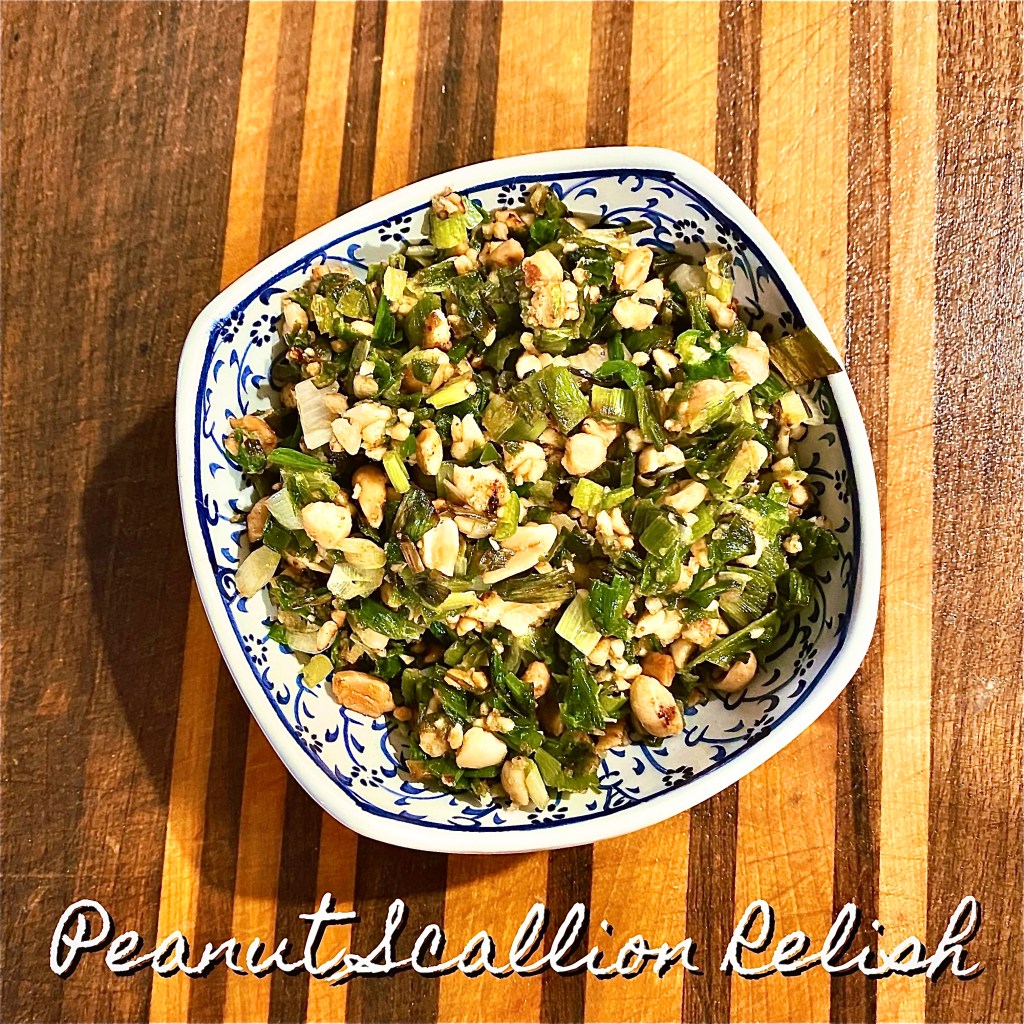
This simple Indian relish makes a great snack, breakfast, or topper for a wide variety of dishes.
Try it tucked into a chapati or roll – with or without an egg, atop a bed of rice (I’m particularly fond of sushi rice), bulked out with sautéed green beans, spread over a protein like chimichurri sauce, mixed into a stir fry (preferably with something sweet like red pepper), or mixed into a salad (this would be great with cucumber and mint).
It seems like the entire Internet has lost its collective mind recently over these wrapped tortillas. I must admit … I was intrigued. I’d never thought to wrap a tortilla like I would a crepe and it sounded like the kind of magical lunch I needed in my life that week.
And then I started looking at recipes. Crunchwrap came to mind first, but the glue was cheese. Whelp, that’s out. I can’t do cheese cheese, and even store bought vegan melting cheese + my GI system are currently on the outs.
A YouTuber I follow (who actually introduced me to this fad; I’m not one of the cool kids on Tik Tok) made a sushi roll version that looked delightful and had rice as the “glue” (I tried recreating it for y’all and have thus far failed in my efforts). Which got me thinking … I’ve got leftover potatoes, and I want Indian. What can I do with that information?
Turns out, I can do a lot. I’m going to give you guys a full meal recipe here, with instructions on how to turn it into one of those cool kids wraps. Which is awesome, but you’ll have leftovers. Just slap the rest in a bowl and call it an Indian harvest spectacular.
Note: This recipe uses mustard oil, which may be difficult to source. I’ve included an Amazon (affiliate) link to help. I also included a link for the chicken seasoning I’ve been using recently and loving, as well as for the condiments.
Gluten-free if you use a gf wrap, vegetarian and vegan if you sub the chicken
Dairy Free Tortilla Wrap
This recipe is written a little weird. I’m laying it out in quadrants in the order you’ll wrap them. More on that later. I cooked mine in kind of reverse order, starting with the potatoes, moving through the protein, and ending with the veg. You may wish to do the same.
Protein Quadrant
Protein of choice (I used chicken cut into bite-sized pieces)
Set your potatoes to boil in a large pot with a generous amount of salt. Boil until cooked through and soft.
Drain and set aside.
While the potatoes are working, chop the onion and garlic fine.
In a medium pan over medium heat, bring the oil up to temperature. Chuck the mustard seeds and turmeric into the oil and heat until fragrant and the mustard seeds start to pop.
Add the onion and garlic and sauté, stirring frequently, until softened and a little brown.
When the potatoes are done and drained, add back to the big pot and mash roughly with a potato masher or beaters. Chunky is fine – I wanted my potatoes to have a bit of heft to them like my favorite Indian restaurant potatoes. Add the onion mixture, the butter, and a healthy pinch of salt. Combine well, taste, and add more salt or fat if needed.
Set aside.
Cut the bottom half down the middle. To assemble, wrap the lower left up, then both of those to the right, then the three to the lower right quadrant.
Assembly
Wrap a large chapati (Mission makes a decent one), roti, tortilla or other flexible and foldable bread in a paper towel. Sprinkle with water and nuke for 15 seconds so it’s bendable.
If you think of your chapati as a wheel with 4 quadrants, you want to cut up the center bottom until you hit the horizontal equator.
Wow, that was some mixed metaphor ish; hopefully followable.
In your lower left quadrant, arrange a little protein. Not overfull – think burritos, here. You don’t want to over fill those, either.
In the upper left quadrant, spread a little condiment.
In the upper right quadrant, add a little veg.
In the lower right quadrant, spread some potato. This quadrant will act as our glue.
To fold, carefully fold the lower left quadrant up (I kind of held the chicken in place as I carefully flipped the chapati up), fold the left side to the right (this went easier), and the top down so the 3 folded sections rest on the potato section.
You should have what looks like a folded crepe sandwich.
Pan fry until golden on both sides, kind of smooshing a bit as you do so it sticks together.
*Internal excitement intensifies* Season 5 of the Expanse is out, and with it, a renewed excitement about the food explored in the series. I’ve been so excited, in fact, that my poor brain has been working over time yet again this season and has been choosing to switch on at 3am to ponder the problem of nutrition in space. Because I’m a nerd and totally fine with that.
Omfg, here she goes with the bold subheadings. Yep. Strap in, folks, I have time on my hands and am willing to go full nerd while espousing my lack of knowledge on the Internets.
About The Expanse
If you have no idea what I’m talking about, the Leviathan Wakes books by James S.A. Corey and accompanying television show – The Expanse – is a massive (9 book and thus far 5 season) Sci-Fi series dealing with politics, inequality, humanity’s spread throughout the solar system, war, profit, cabals, and external forces. In broad, non-spoilery terms at least. There’s So. Much. More.
The world building is phenomenal, and the attention to scientific detail (I mean c’mon … the show had me at the opening dealing with gravity) gives just enough meat for the non-scientific at least to run with. It’s like two of my other Sci-Fi loves – Battlestar Galactica and The Martian had a huge baby.
This explanation isn’t doing either series any justice at all. Suffice it to say that it’s great and I would be shocked to hear that it isn’t being used as a teaching tool in at least some discipline of college course.
Food is a big part of the books (at least it’s mentioned frequently and is used to convey information about the characters, location and politics), and I’m super fascinated in what the food of this world tastes like.
What the food is made of, what the flavor profiles are … who are these people, and what do they like? They aren’t (all) subsisting on military-style MREs, but they’re in space … so lobster is probably right out. Where did these people come from on Earth? They’re not all North American in ancestry – the UN runs things at least ostensibly; not necessarily the US (although it is an American series written in English, so there’s definitely a sense that at least geographically a lot of the Earth references are from there, if not political power as well).
Before I get too lost in the Food Nerd weeds, today’s recipe is one I’ve been mulling over since I first read the books. Quite a few mentions have been made of noodles with mushrooms or noodles with black sauce – or both. In my mind, given the fact that the Outer Belt is populated heavily by people of broad Asian descent, black sauce brings to mind Korean-Chinese Jajangmyeon (fermented black bean sauce), which is the absolute bomb but which I can’t source the ingredients for easily.
Reddit seems to agree with that assessment, and mention is made of hoisin sauce possibly being a substitute flavor profile.
I tend to lean toward a vegan analog for butter taste mixed with a bit of grease like takeout Chinese noodles have, mixed with delicate mushrooms, black vinegar and a bit of hoisin or oyster sauce mixed in. With garlic powder. Spices are a thing, and I refuse to believe that humanity has abandoned garlic.
Personally, I would add something green like bok choy or something with some nutrition, but food is political in this world, and fresh veggies would be hard to find, I imagine. This is poor people food – and the poor in this society don’t even have free and clear access to adequate oxygen, let alone stable food supply lines and proper nutrition. No veggies for me. (Mostly) shelf stable, it is.
Back to non directly recipe-related Nerdery.
Egg Noodles & Space Chickens
In the books, reference to egg noodles is made (specifically in Leviathan Wakes, Miller stops at a noodle cart for a cheap cone of egg noodles in black sauce). Egg is also referenced elsewhere in the books, though of course I can’t put my finger on the exact book or framework for that reference – I believe mention was made of a “real” breakfast sounding like it most likely featured meat and some sort of ship eggs – which may or may not have been vegan eggs.
Quite understandably, real meat from an animal is expensive in this world – and I would imagine not only expensive, but super rare for those in the Outer Belt far away from Earth. As far as I can figure, Earth would be the only place with enough land and resources to support any sort of large scale animal farming – or farming of any animals larger than rabbit (I don’t believe, however, that mention is made of rabbit).
Mention is made of vat grown meat, and farmed salmon for sushi – which makes sense mostly, though that’s a lot of water.
But chickens? Yeah, you can have chickens on a balcony in a city and still get eggs, but to have enough chickens to make enough eggs that egg noodles can then be sold cheaply to Belters – that’s a lot of feed, which requires a lot of water, and unless your chickens are running around the ship loose, a lot of dedicated chicken space. Which wouldn’t be wasted – chicken poop makes good fertilizer.
But still … I can see it being a viable protein source somewhere like Ganymede where large scale farming is being conducted, and I suppose big stations like Tycho must have some sort of food production capacity, but you’ve got to have a bunch of chickens to get a stable breeding population – and roosters – to be able to manage all that. Or, would it be more cost-effective to cycle your chickens into stew every 4 years or so when they stop laying to start fresh with a new crop?
How quick are ship times? Can you sell chicken poop for a profit?
I don’t know. If you have more information on this or see big holes in my logic, even if it’s years from now and we are on Season 9 (fingers crossed), let me know in the comments. I’m super interested in this stuff and know next to nothing about it.
For the purposes of this recipe, I’m not sold on egg noodles – despite them being mentioned in the book. I’m leaning toward rice noodles or shiritaki noodles being more plentiful (though shiritaki probably don’t have enough calories to be a viable nutrition source).
Is wheat a thing in this world? I don’t remember seeing any reference to fresh bread – and I can imagine, at least for our Earther protagonist from Montana, that would be a big comfort smell. Like coffee, which is definitely still a thing in this world, even in the Outer Belt (though coffee can be made from a plethora of things – and is definitely used as a plot device to show wealth and power).
Still. I don’t think bread has been mentioned, so what are these egg noodles made out of? Eggs & rice? Keto-style egg ribbons? JUST eggs?
Water in Space
Water. Water is expensive and has been a limiting factor to how large societies can grow since humans decided to clump together. It stands to reason that this continues on into the great beyond, and access to water is one of the tools of subjugation used to keep the Outer Belt under control by the Inner Planets.
This world also mines water off of space rocks and shuttles it around – so I’m thinking this restriction is more political than practical. Correct me if I’m wrong, but I believe rice takes more water to grow than soybeans. According to a January 2013 report published by the Institution of Mechanical Engineers, it takes 2,497 liters of water to produce 1kg of rice, but only 1,849 liters of water to produce the same amount of dry pasta (I’m assuming regular wheat pasta) and 196 liters of water for 1 egg. So. If they have enough water for rice, which is also referenced in the book (specifically rice noodles with mushrooms in Babylon’s Ashes), maybe chickens *are* more widespread.
This article from FAO.org details water consumption due to environment and growing cycle, and has soybeans listed as needing 450-700mm of water during the growing period. Rice needs the same amount; wheat needs 450-650mm.
I would imagine that any space set up for farming can be kept at a consistent perfect growing environment – you can have a room set up like South Carolina or Vietnam to grow rice in, right next to the Ohio room growing wheat and soybeans. That makes sense. Still takes a lot of space to produce enough food to feed people, but that’s also a gripe The Belt has about The Inners – access to food.
I had assumed wheat takes too much space and dirt to grow at a functioning agrarian capacity – but maybe that chicken poop (and human poop) helps there? I would imagine compost would be necessary as well. (Although .. what else do you have to compost but poop? I can’t see single-use items being popular aside from recycled paper, and how much nutrition is supplied by vegetables vs some sort of vitamin? I can easily see food food being necessary as a caloric supplement rather than nutritional necessity – ooh. Snowpiercer did a good-but-terrifying job here).
Veganism in space
I still assume that most people living full time in the Outer Belt are at least mostly accidental vegans. Cheese is mentioned in the books, but as a rare delicacy and symbol of the “fat cats” on Earth. I think Earth is the only place with cows and dairy. I don’t think there are Martian cows in this world.
Salmon is mentioned for sushi, but not as something people we know are actually eating – as is vat meat (I still think this could be something like Beyond Burgers instead of actual muscle tissue; but who knows? It’s scientifically possible even now, and we have yet to crawl out of our gravity well in any long-term manner).
I stand by the accidental vegan. Maybe with eggs. Or are they vegan eggs and no one thinks to mention otherwise because chicken is space suits is a stupid question?
Also going out on a limb here and saying honey isn’t really available – I can’t imagine that if Earth has enough people it needs to send some out to colonize, we’ve gotten our ish together regarding bees. Which opens up a whole other deal regarding vegetables and extinction …. but that’s too far of a digression for today.
These are the questions that keep me up at night.
Other Belter Foods If You’ve Read This Far And Are Still Curious
If you’re curious about other Belter food, I also recreated Red Kibble – which was also delicious – and have a whole long dive into cultural influences of flavor on that recipe.
Less successful was my foray into Indo-Chinese Singapore-style noodles, which I did not bother posting but really need to revisit. Also: adding Greek flavors into that mix would be fascinating.
And if I can figure out better TVP sourcing, I’d like to attempt White Kibble as well. I don’t think what I have in my head (Southern style white gravy) is what it would actually taste like.
—-End Nerdy rant and on to the actual recipe—
Today’s recipe is: gluten-free, vegetarian and vegan
Belter Style Black Sauce Mushroom Noodles
1 serving rice noodles (I chose to go with wide noodles, because I wanted something with a touch of bounce. I think texture would be a big thing in this world. I’ve seen other versions using Udon – and egg noodles are mentioned in the book)
1 package Enoki mushrooms (I wanted a delicate mushroom here – one I could see easily taking the place of noodle bulk when noodles are scarce. Something meatier like a portobello or Shiitaki minced would also do – if you use the whole package for 1 person, that’s probably a bit on the baller side for this dish – but it was delicious and I have no ragrets)
2 tsp. ghee or vegan butter (This is possibly a stretch for this world, but butter & mushrooms … ghee is probably not a thing, but vegan butter or some sort of butter analog very well may be – at least on the Stations – I have ghee, so I’m going with that rather than butter butter)
2 tsp. oil (most likely peanut or some other high smoke point neutral oil – I’m using safflower oil, since that is what I have on hand)
1 Tbsp. black vinegar (a fermented vinegar popular in Chinese cooking)
1 Tbsp. Hoisin [also popular in Chinese cooking and I can’t see why some version of this wouldn’t be available. If not, a little oyster sauce + a slack sprinkle of sweetener (but probably not cane sugar) would do well here – or, if you, like me, think you have those sauces but do not – a teaspoon of ketjap manis (sweet soy) + 2 tsp. Bulldog (Japanese Worcestershire) work really well]
Garlic (I wanted to use crispy fried garlic discs so badly in this dish, but while I think garlic is probably available, I think it’s more likely that a cheap & cheerful hawker stall would be using garlic powder – maybe in one of the bars or somewhere with internal seating would have real garlic. I’m going for street stall-ish here, you do you)
Optional toppers: Green onions (maybe not in the street stall version, but I need some bright freshness in my life), and topper condiments like more black vinegar, some soy sauce and chili oil. I’ve got to believe that future hawker stalls will have the customization options available in NYC Chinatown’s dollar dumpling shops
A hand full of chicken analog TVP (probably a little flash for a street stall, but if we are conceding that TVP chunks exist for Belter Kibble – which is also a food of the oppressed – strips also probably exist and are at least mostly readily available. The cost of the mushrooms may balance the cost of the TVP out for a hawker stall version of these noodles, though)
If you’re using TVP, prepare according to package directions. I did not, but only because I could not be bothered to boil them for 8 minutes. I would imagine these would be an easy keep-on-hand prepped item for a hawker stall.
Boil your noodles until almost cooked through and drain.
Assemble the rest of your ingredients, and fire your largest pan up to medium-high – this will go quick.
Add the oil and heat to shimmering. Toss in the mushrooms and TVP if you’re using, and let cook, stirring frequently, until the mushrooms get a bit of color.
Sprinkle liberally with garlic powder, add a Tablespoon of Hoisin (or your other sauces), and a Tablespoon of vinegar.
Add the noodles and butter analog and toss quickly to combine.
Why Mexican Flag? Something about the green, white and red just makes me happy with this recipe. I had also forgotten how much I actually enjoy frozen corn kernels, so this was a great opportunity to indulge in a bunch of that.
I also served this mixture as a topper for some pearl barley a few nights later, and it was also awesome. This would make a great topper for pastas or roasted potatoes for a crowd if you want to stretch the ingredients.
gluten-free, vegetarian, vegan
Mexican Flag Vegan Tacos
8 oz. sliced mushrooms (I used crimini)
1 small white onion
1-3 red peppers (I used about 1/4 of a cup of long semi-hot peppers), diced
1-3 green peppers, diced (I used about 1/4 of a cup of a mix of hot and semi-hot peppers)
1 c. frozen corn
1/4 c. cilantro, chopped
1 tsp. oregano
2 Tbsp. smokey chipotle seasoning (or your fav. taco mix)
2 tsp. cumin
2 cloves garlic, minced
Neutral oil
Juice of 1 lime
Taco fixins:
Raw breakfast radishes, chopped fine
Cherry tomatoes, at least halved
Choula
Your favorite tortillas
In your largest pan, heat 2 Tbsp. oil over medium high until shimmering. Add the corn and mushrooms and sauté until the corn defrosts and mushrooms start to look like they may cook.
Add all but 2 Tbsp. of the onion and the garlic and sauté until the mushrooms give off a bunch of liquid.
Add all but 1 Tbsp. of each color of the peppers plus the spices and sauté until the peppers are softened.
Taste for seasoning, adding more if necessary.
Kill the heat and mix in the cilantro, lime juice, reserved raw onion and reserved raw peppers.
Serve as tacos as pictured or as a topper for something else. The toppings make enough to serve 4 as a taco, and can stretch further if needed





 Gastography