Roasty Toasty Winter Bisque

Creamy Liquid Nutrition

Roasty Toasty Winter Bisque

Did you know that you can peel pumpkin, butternut squash or any other thin-skinned winter squash with a speed peeler? Well, I didn’t until I saw one of the pumpkin pros on Food Network’s Halloween Wars do it, and man, does it make a difference. You see, I used to use a Chinese-style meat cleaver to break into my squash, and rather than dirty up a perfectly good knife to use as a peeler, I would use said cleaver to peel my squash. Now, over the years I’ve gotten pretty dexterous with that cleaver, but using a speed peel wastes way less of the tender flesh, and may even be a bit easier. Maybe. It freaks onlookers out less, too, which may or may not be a good thing, depending upon your proclivities.

You know what’s great about winter soups? They’re healthy as shit. You’re basically eating liquid vegetables here, and the dairy? I can totally handle 2/3 c. + a little fat spread out among 4 servings if it comes with an entire day’s worth of vegetables. 4 4 3 2, bitchez! (yes I’m aware there’s now some plate thingie instead of 4 4 3 2, but lessons with songs die hard)

If you don’t want to spring for a whole container of creme fraiche, Greek yogurt might make a good substitute here. Or cream cheese. Anything creamy in the dairy family would do, even sour cream. You’re going for a little zing, a little cream, a little thick. Go on, play with your food. You know you want to.

Roasty Toasty Winter Bisque

Adapted from Roasted Pumpkin Bisque from Whole Foods

5 lb. winter squash – I used a sugar pie pumpkin and butternut squash
2 yellow onions, chopped
1 Tbsp. thyme, chopped
3 Tbsp. olive oil
6 c. chicken or vegetable broth
1/2 c. white wine (whatever you have on hand that’s drinkable)
1 tsp. ground cardamom
Juice of half a lemon
Roasted squash seeds (see recipe below)
2/3 c. creme fraiche (optional)

Preheat your oven to 425 F. Toss the squash, onions, thyme & oil and spread onto baking sheets in a single layer. Salt & pepper to season, and roast 30 mins. or until tender and just starting to brown around the edges (you may want to stir once or twice to prevent burning and feel useful – if that’s you, knock yourself out. I didn’t and mine was just fine). Once the squash is done to your liking, remove from the oven.

This would be a great time to add those squash seeds to the (now vacant) oven.

Transfer squash + friends to a large pot. Add the broth, wine & cardamom and simmer 10 minutes. Blend with an immersion blender** (or however you blend soup – in batches in a blender, whatever) until smooth. Add the lemon, stir and taste. Does it need salt or pepper? Add it now. Bring your soup back up to a simmer and kill the heat. Remove from the burner and whisk in the creme fraiche. Serve with crusty bread or a nice peppery arugula salad.

Serves 4 for dinner, or 2 for dinner with 2 big lunch portions.

Roasted Squash Seeds

Take the seeds from your peeled squash from the above recipe. Clean and place in a small bowl.

Add 1 tsp. each cumin, chipotle powder, cinnamon and brown sugar. Toss with a splash of olive oil and a big pinch of salt.

Spread out on a baking sheet and bake ~5 mins. or until browned but not burnt. Be careful here. Ideally, the oven would be at 350 to bake squash seeds, but I like to live on the edge. Just babysit your seeds and they will be fine. A little blackened on the edges is tasty, too, just make sure they’re done enough (read: dry and browned) or the texture will be off.

**A note on immersion blenders: If you make soup more than once a year and/or enjoy the occasional smoothie, buy one already. You can get them on sale for under $25 almost any month of the year if you look, and they are worth it. They hardly take up any space, and if you will use it more than once a year, it is a great investment. This is a tool I broke down and finally bought this year. I thought for years that they were a: too expensive, b: too much of a unitasker and c: something I could totally live without – people lived without them for thousands of years, after all. *Horn Sound* Wrong (except for the thousands of years bit).

For the kitchen accident prone like me, this method of soup blending has become invaluable. There is zero chance of spilling mass amounts of hot liquid on yourself or for dinner to come crashing to the ground because you lack the arm strength to pour soup from a huge pot safely. Also, splatters with the immersion blender are waaaaayyy smaller than splatters with a bar blender. Just sayin’. Having one of those puppies blow up in your face because you put the soup in while it was too hot and the steam got over zealous isn’t the most fun you can have on a weeknight. Nor is leaking soup out of the bottom of your food processor.

Isn’t $25 worth peace of mind? For me it has become so. I love my stick blender. And as an added bonus, it feels “chef-y” too. So there’s that.
Canadian? Bacon — Charcutepalooza Challenge #4

I’ve always wondered what made Canadian bacon Canadian. Is it that Canadians don’t know how to make real bacon? Does it have something to do with Virginia and hams? was it originally a marketing ploy by McDonalds? How many degrees away is this from Kevin Bacon?

You don’t know either? Let us then take a culinary detour of sorts to discover the real roots of this bacon.

Canadian, aka back bacon or Irish bacon isn’t Canadian at all. Not really. It’s more of a Canadian-English-American hybrid super bacon.

Canadian bacon comes from the lean pork loin, which is located in the middle of the back. It is then brined and smoked.

According to Kitchen Project, this type of savory pork was most likely dubbed “Canadian” by marketers in the United Kingdom who took to importing pork from Canada to deal with a shortage in the mid 1800s.

This imported bacon was prepared Canadian-style (unsmoked and brined) and rolled in ground yellow split peas (or some other form of fine yellow meal) to aid with preservation. In Canada, this type of cured bacon is still common in parts and is called Peameal bacon.

When the English got their porcine packages, they added smoke and didn’t bother to change the name. Emigrating bacon lovers brought the new concoction to the States and Canadian bacon as we know it was born. Isn’t globalization great?

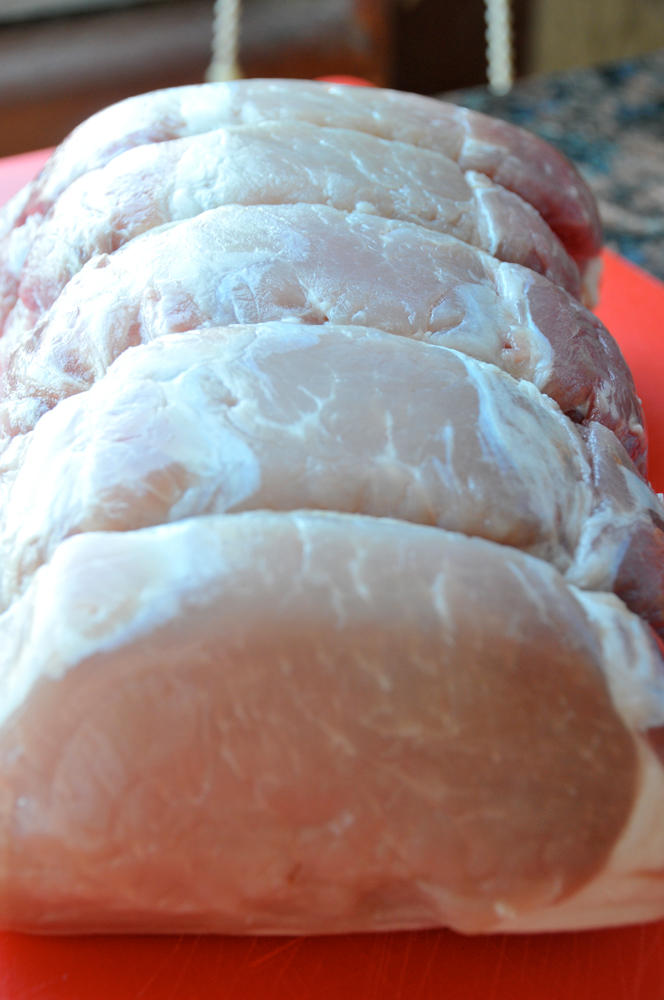
Mmmmm…. pork loin…..

This slab o’ pork wasn’t nearly as hard to find as the pork belly. My friendly neighborhood butcher at Laurenzo’s Italian Market had it on hand and was more than happy to hand me the tastiest looking roughly 3 lb. pork loin in the case.

Since this preparation is all about the smoke, I broke down and purchased a stovetop smoker (Camerons large from Amazon). The smoker is compact, looks easy-to-use and presents as a neat silver self-contained package.

Ok, so I forgot to take a nice beauty shot of the smoker before it got not so nice looking but smoky.

The brine for this preparation was simple; just tons of water, Kosher salt, pink salt, table sugar, garlic, thyme and sage.

Ever feel like a serial meat drowner?

I popped the loin in, waited 2 days, took it out, wiped it off and slapped it on a tray to air cure in the fridge for a few days.

All brined up and nowhere to go
Ok, so it has somewhere to go…

And then my smoker finally came in from Amazon, and we were off!


Alder chips/dust for smoking


The lid didn’t quite sit perfectly over the hump of meat, so I wrapped the smoker in foil

I smoked my pork centered on one burner over medium with Alder chips for a couple of hours. It smoked the house out a bit, but not unbearably so (keep in mind that smoke is sticky and if you don’t want your kitchen and/or house to smell like someone’s been cooking bacon for a week, make sure to clean anywhere the smoke could have gotten thoroughly).

Deeply smoky pork exterior
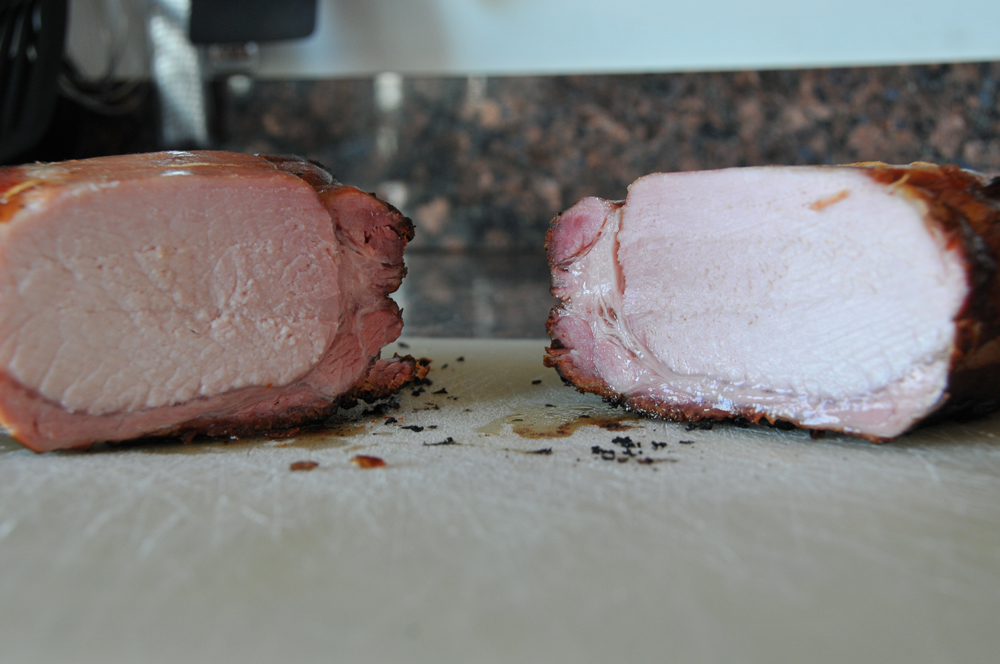
Smoky but not quite so baconed interior

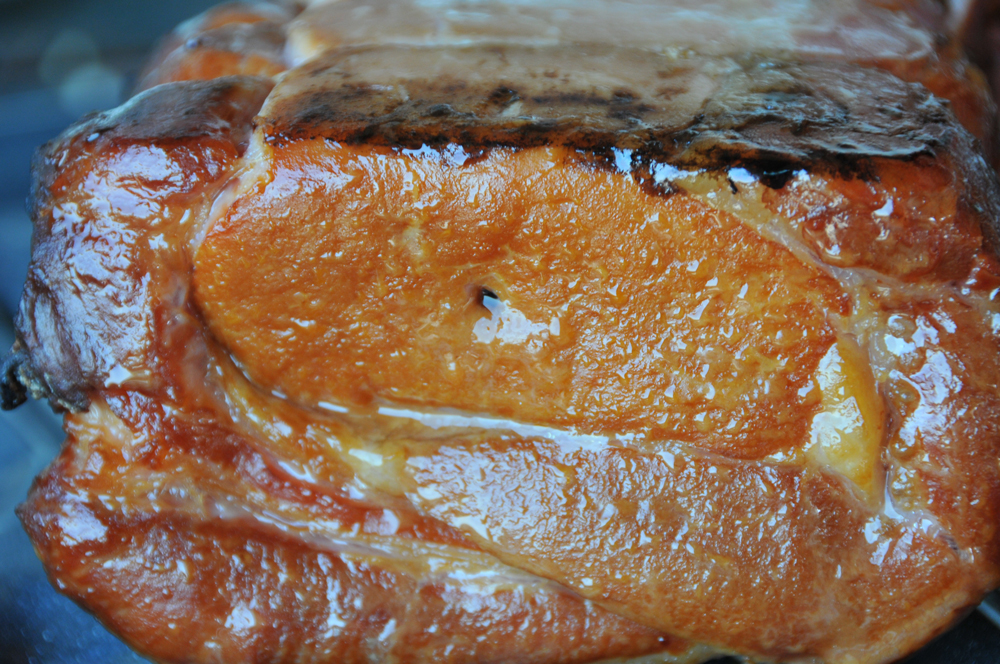
The final product was meh. Not terrible, not great. The outer portion on the outside of the fat cap looks and tastes like Canadian Bacon, but the inside looks and tastes like a pork roast. A deeply smoky pork roast at that. I think where I went wrong was the nice thick pork loin. Had I used one of the thinner loins, I think it would have turned out just right. Live and learn.

I’ve been racking my brains trying to think of a new vehicle in which to premiere the Canadian Bacon, but to no avail. I tossed a handful in with some greens and a fried egg, and it was not my favorite. Entirely edible, but I liked the dish sans smoke better.

I’m thinking maybe a soup. Maybe even the split pea soup my DH has been begging for for months will do this “bacon” justice.

Split Pea Soup

A Much Better Use of Canadian Bacon–Split Pea Soup
Adapted from Split Pea Soup with Country Ham from one of my favorite food blogs, Orangette

6 oz. fresh Canadian Bacon, cubed
1 large Vidalia onion, chopped
3 carrots, chopped
2 c. dried split peas
8 c. water
Cap full of apple cider vinegar
Salt & white pepper to taste
Olive oil
Crusty bread (optional)

Add1 Tbsp. olive oil to a large heavy-bottomed pot over medium-high heat. After the oil heats up, add the bacon and cook, stirring, until starting to brown.

Add the onion and carrots and cook, stirring to avoid burning, until the vegetables are tender but not browned (roughly 10 minutes).

Add the split peas and water. Bring to a boil, reduce the heat to simmer and cook 90 minutes to 2 hours or until the peas have broken down.

Taste, add the vinegar if the taste needs punch; salt & pepper to taste.

I covered the pot while cooking and the resulting soup was more watery than I like. So, I grabbed my slotted spoon and got to work separating the bacon from the vegetables and excess liquid.

If you want a more refined-looking soup at this point, let the soup cool a bit and blend the vegetables and desired amount of liquid until smooth, add back to the pot along with the reserved bacon and heat through to serve.

Serve with a nice swirl of olive oil to finish and thick slabs of crusty bread for sopping.

Serves 1 hungry deprived husband for dinner with enough left over for you too, if you don’t get too close.

Canadian? Bacon — Charcutepalooza Challenge # on Punk Domestics

What to do with a box of vegetables: CSA box #3

2011 CSA Box 3

8 oz. local Florida strawberries

6 oz. blueberries

5 fair trade bananas

2 local Florida ruby pink grapefruit

2 small butternut squash

4 yellow onions

8 yukon gold potatoes

3 small heads broccoli

1 head cauliflower

3 medium and 2 small red beet roots

5 oz. bagged spring mix salad greens

2 hass avocados

3 roma tomatoes

1 bunch rainbow chard

How I Used My Share

  • One of the grapefruit supremed in a big salad with the spring mix, crisped bacon, shredded fontina cheese, half the container of blueberries and a handful of chopped sundried tomatoes with a grapefruit whole-grain mustard vinaigrette.
  • The other grapefruit with the avocados in a chicken and bulgur salad with fennel.
  • Four of the potatoes diced as hash browns as breakfast for dinner with home made bacon, leeks and eggs.
  • Cauliflower in a barley salad with almonds and capers.
  • Tomatoes roasted for a slow-roasted tomato jam.
  • Chard and half the onions in a barley and split pea soup.
  • The other half of the onions in a slow-cooked bacon jam.
  • Most of the fruit I ate out of hand.

I pickled the beets because I am desperately looking for more ways to make them not taste like dirt and my father tells me often they are the very best way to eat them. They are pickling as I am typing. I’m skeptical, but we shall see.

Left over: Butternut squash, four potatoes, broccoli

My Favorite Recipe From This Box

Eggs & Hash Browns With Fried Eggs and Leeks

My Favorite Recipe Not Shared Previously

Barley and Split Pea Soup with Chard
Adapted from Bon Appetit Magazine

This soup is light and healthy tasting while still being satisfying. I ate this for dinner and then again for 2 days for lunch, and it got better with each meal.

1 Tbsp. olive oil
1 1/2 c. chopped onions
1 1/2 c. chopped carrots
3 large cloves of garlic, minced
2 1/2 tsp. cumin
10 c. chicken or vegetable broth (my favorite is Better Than Bouillon goo mixed with water)
2/3 c. pearl barley
14 1/2 oz. can diced tomatoes (I used San Marazano)
2/3 c. split peas
1 bunch Swiss Chard, chopped
2 Tbsp. fresh dill (don’t skip this ingredient, it brought a great unexpected taste to the party)

Heat the oil in a large heavy pot over medium-high heat. Add the onions and carrots and sauté until the onions are golden brown and delicious, roughly 10 minutes.

Add the garlic and cook, stirring, 2 minutes. Mix in the cumin and cook, stirring, until it releases its scent, about 1 minute. Add the broth and barley and bring to a boil.

Reduce the heat to medium-low, partially cover the pot and simmer for 25 minutes. Stir in the tomatoes (with juice) and the split peas, cover, and simmer about 30 minutes until the barley and peas are tender.

Add the chard, cover, and simmer roughly 5 minutes until the chard is tender. Stir in the dill and season with salt & pepper to taste.

1 Year Ago

8 oz. local Florida strawberries
6 oz. blueberries
7 valencia oranges
1 kent mango
1 huge lime
5 jalapenos
2 heads garlic from Argentina
2 Haas avocados
1 bunch cilantro
2 huge local Florida roma tomatoes
2 jumbo red onions
scallions
2 ears local Florida bi-color corn
1 bunch local Florida lactino kale
1 head romaine lettuce
3 heads broccoli
2 large russet potatoes

What I made: Ginger Fried Rice, Thai Black Rice Salad, Cilantro Lime Rice, Stir-Fried Kale & Broccoli, Carnitas Tacos, Jalapeno Salsa, Broccoli & Chicken Stir-Fry, Lemon Smashed Potatoes

2011 CSA Box 1

2011 CSA Box 2